
Mens ponytail hairstyles have moved well beyond the territory of counterculture statement or athletic convenience — they’ve become one of the most genuinely versatile and stylistically rich options in the entire men’s hair conversation. Whether you’re growing your hair out intentionally, maintaining a long style you’ve worn for years, or simply exploring what longer hair looks like on you, the ponytail is the style that grows with your journey and rewards every stage of it. From sleek and polished to loosely textured and deliberately undone, these 21 variations prove that tying your hair back is one of the most confident, characterful choices a man can make.
1. The Low Sleek Ponytail — Refined Masculinity at Its Most Composed
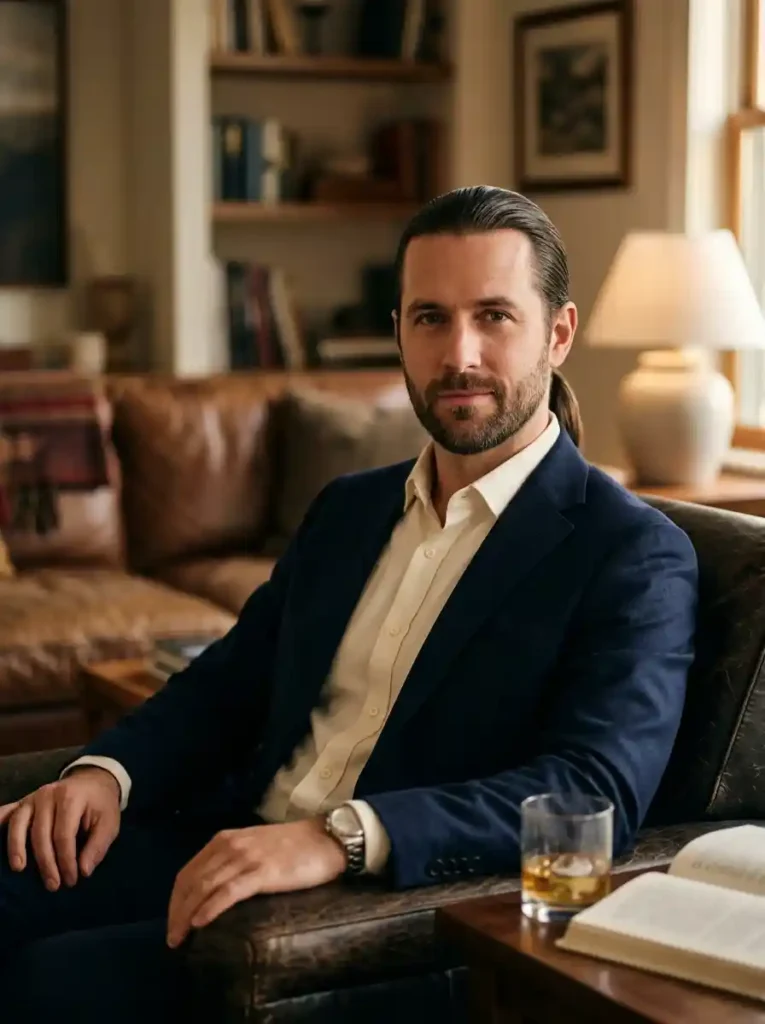
The low sleek ponytail sits at the nape of the neck with every strand directed cleanly backward — no flyaways, no escaped pieces, just smooth, intentional hair pulled back with the kind of precision that communicates something specific about the man wearing it. This is the mens ponytail hairstyle that works in professional environments, formal events, creative industries, and elegant social contexts because its cleanliness reads as grooming sophistication rather than casual convenience. When you pull your hair back neatly and wear it deliberately, the style functions as a visual statement about personal standards.
The sleek quality requires preparation — apply a light smoothing cream or a small amount of hair serum to slightly damp hair before brushing everything backward with a natural bristle brush, then secure with a seamless elastic that won’t leave visible marks when removed. The nape placement at the base of the skull is the most universally flattering position for this style because it creates a clean, elegant line from forehead to ponytail base that emphasizes the neck and jaw in a way that mid or high placements don’t quite achieve. A tiny amount of light-hold hairspray smoothed over the surface with your palms tames any remaining surface texture and locks the sleek quality in place through the day.
2. The Low Loose Ponytail — Effortless Cool That Never Tries
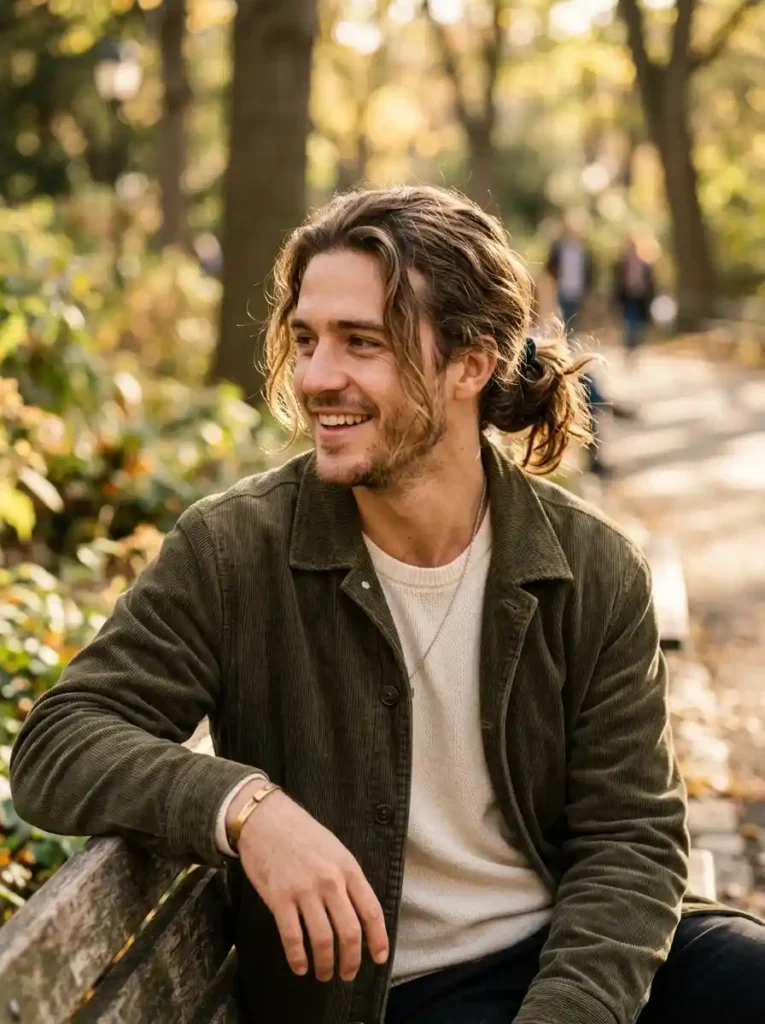
The loose low ponytail is the opposite of its sleek counterpart in philosophy and identical to it in impact — where the sleek version communicates refined precision, the loose version communicates a relaxed self-assurance that is equally compelling in completely different contexts. This is the style of a man who has excellent hair, knows it without being precious about it, and simply gathered it back in about thirty seconds without any particular investment in perfection. The face-framing pieces that escape at the temples and nape are not styling failures — they are the entire point of the look and the source of its considerable appeal.
Achieving the right quality of intentional looseness requires resisting the impulse to smooth, tighten, or refine the result once the elastic is in place. Pull the ponytail base slightly away from the head to loosen the tension, allow two or three pieces to fall forward at the temples and a few wisps at the nape, and then leave it entirely alone. Sea salt spray applied before gathering adds natural texture and slight separation that makes the loose quality look genuinely organic rather than staged. This style photographs with extraordinary warmth in natural light — the slight imperfections and natural movement create dimensional depth that perfectly polished styles simply cannot replicate with the same candid authenticity.
3. The High Ponytail on Men — Bold and Unapologetically Modern
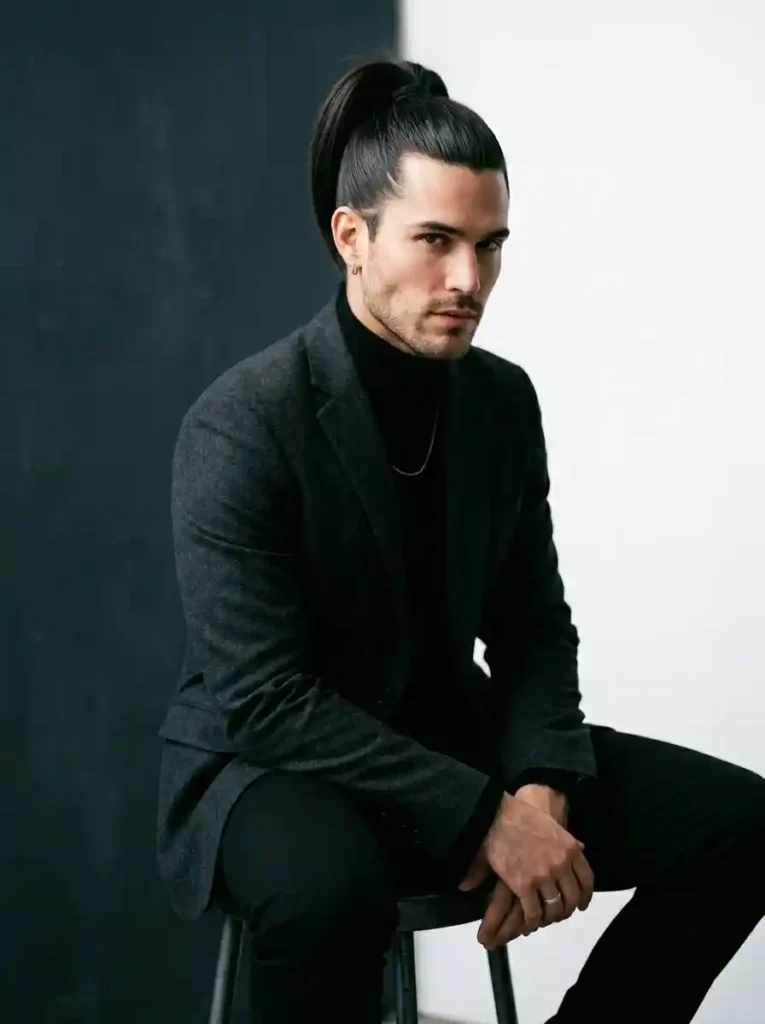
The high ponytail on men is the most visually dramatic and stylistically assertive position in the entire ponytail spectrum — pulling all of the hair upward to the crown creates a clean, graphic silhouette that changes the entire architecture of the face and neck, elongating the neck, exposing the hairline and ears, and creating a head shape that reads as deliberately designed rather than simply styled. Men who wear the high ponytail with genuine conviction look incredibly compelling — it’s the style that signals complete comfort with one’s own appearance and zero concern for conventional limitations on masculine styling.
The high ponytail works best on longer, straighter or slightly wavy hair that can be gathered smoothly upward without significant volume or texture fighting the direction of the gather. Apply a light smoothing product to damp hair before blow drying everything upward, gather firmly at the crown using a strong but seamless elastic, and resist the impulse to loosen or lower the placement if it feels unfamiliar initially — the slightly uncomfortable feeling of a genuinely high ponytail is simply the unfamiliarity of a new sensation rather than evidence that the style isn’t working. Give it thirty minutes and the feeling normalizes completely while the visual impact continues to deliver throughout the day.
4. The Ponytail with Fade Sides — Two Worlds Perfectly United
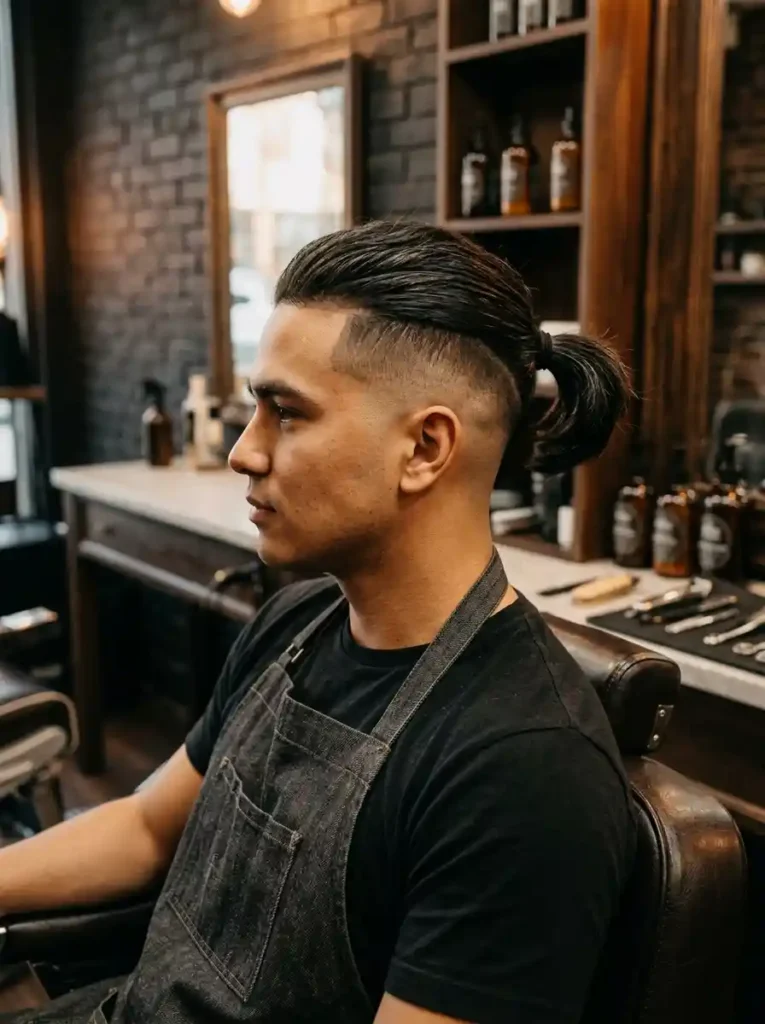
The combination of a clean fade on the sides and back with a longer top section gathered into a ponytail creates one of the most visually interesting and technically sophisticated men’s hairstyle compositions available — it merges barbershop precision with the free-flowing character of longer hair styling in a single look that clearly required skill and intention at every stage of its creation. The close-faded sides create a clean, architectural frame for the face, while the ponytail above provides the length and movement that gives the style its personality and distinguishes it completely from a standard fade haircut.
This combination requires maintaining two completely different hair lengths simultaneously — the faded sides need refreshing at the barbershop every two to three weeks to maintain the clean gradient, while the top section requires the conditioning and care that longer hair demands to stay healthy and ponytail-worthy. The fade height dramatically affects the overall character of the style — a high skin fade with the ponytail creates the most dramatic contrast and the most fashion-forward appearance, while a low taper with the same ponytail creates a subtler, more conservative result that suits professional environments without sacrificing the character of the long top. Discuss both options with your barber using reference photos for the clearest possible communication.
5. The Textured Ponytail With Natural Waves — Embracing What You Have
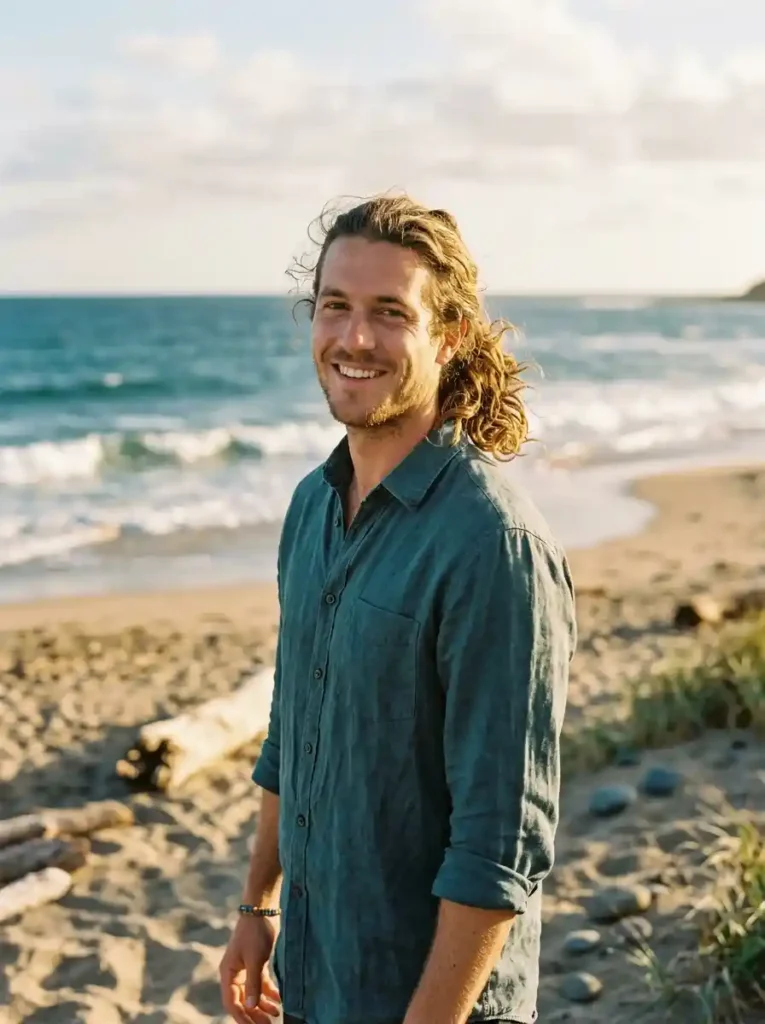
The textured ponytail that retains and celebrates natural wave is the style that finally makes men with wavy or slightly curly hair feel like their hair type is an asset rather than something to be managed or tamed into submission — because the wave creates dimensional texture throughout the gathered ponytail that straight hair simply cannot replicate with the same organic richness. Each wave catches light at a different angle, the subtle coiling and movement creates depth and visual interest from every viewing angle, and the overall effect is a ponytail that looks like it belongs to someone who spends time outdoors in beautiful places and is entirely comfortable in their own skin.
Styling this ponytail begins before the gathering — apply a lightweight wave-enhancing cream or sea salt spray to damp hair and allow it to air dry or diffuse dry before gathering, so the natural wave pattern is fully expressed rather than being pressed flat by wet-hair tension during the securing process. Gather the ponytail with enough looseness to allow the wave to continue expressing itself through the gathered section rather than being pulled taut and straight by excessive tension at the elastic. The result is a ponytail with genuine movement and dimensional texture that responds beautifully to any breeze or movement — a living, breathing style that photographs magnificently and feels genuinely comfortable throughout the day.
6. The Ponytail With Undercut — The Modern Viking Aesthetic
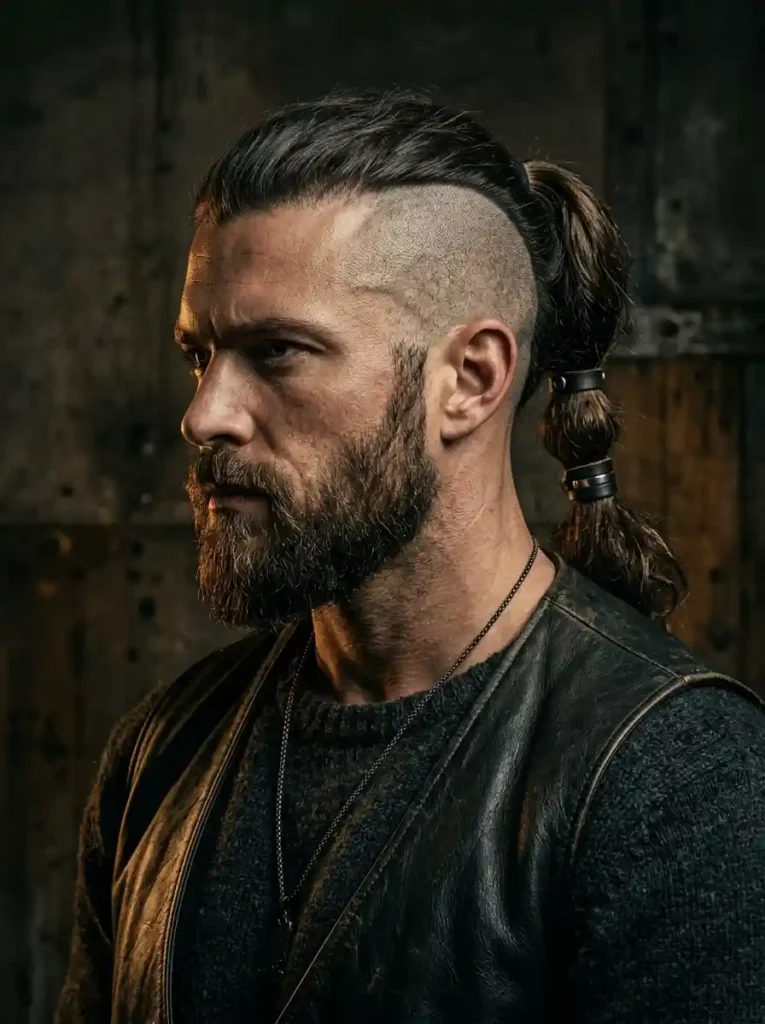
The undercut ponytail is the most architecturally dramatic option on this entire list — the closely clipped or shaved sides and back create an extreme disconnection from the longer top section, and when that top section is gathered back into a ponytail, the result is a silhouette that references Viking warrior iconography, modern editorial fashion, and contemporary barbershop excellence simultaneously in a single look. The shaved sides frame the ponytail above in a way that makes it appear to emerge from the crown like a deliberate design element — sculptural, intentional, and completely unlike any conventional men’s hairstyle in the most compelling possible way.
The maintenance of an undercut ponytail involves two completely separate grooming disciplines — regular barbershop visits to maintain the close-clipped or shaved undercut sections every two to three weeks, and daily hair care for the longer top section including conditioning, heat protection when styling, and protective handling to prevent breakage at the elastic point where the full weight of the gathered hair concentrates tension. A seamless elastic rather than a standard hair tie at the ponytail base prevents the chronic breakage that conventional elastics cause at the gathering point over time. Men who grow and maintain this style discover they consistently turn heads at every social context — it’s a haircut that doesn’t allow itself to be easily ignored.
7. The Curly Men’s Ponytail — Natural Texture as the Statement
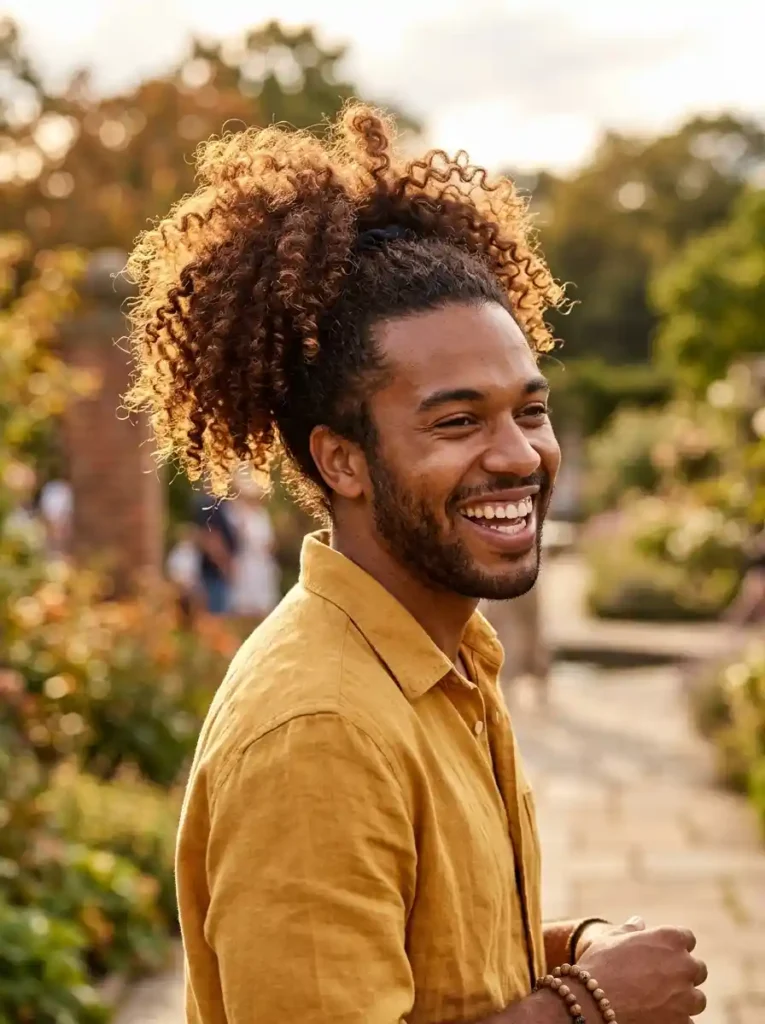
The curly men’s ponytail is the style that finally puts natural curl texture in its rightful position — not as something to be smoothed, tamed, or apologized for, but as the starring element of a hairstyle where the texture itself is the point and the entire visual appeal. When naturally curly hair is gathered upward into a ponytail and allowed to spring and bounce freely from the secured base, the individual curls create a three-dimensional, light-catching composition that no straight or wavy ponytail can replicate with the same organic energy. It has genuine movement and life that makes it mesmerizing in person and extraordinary in photographs.
The foundation of a great curly ponytail is the moisture routine that keeps the curl pattern defined and the hair healthy enough to spring freely without frizz or dryness undermining the natural texture. A leave-in conditioner or curl cream applied to freshly washed, soaking wet hair before air drying or diffusing ensures the curl pattern is fully expressed before gathering — attempting to gather dry, unproducts curly hair results in a frizzy, undefined bundle rather than the voluminous, spring-loaded composition that well-moisturized curls produce. Use a seamless elastic and gather with enough looseness to allow the curls to maintain their individual definition rather than being compressed into a single undifferentiated mass at the elastic point.
8. The Ponytail With Middle Part — Balanced and Deliberately Modern
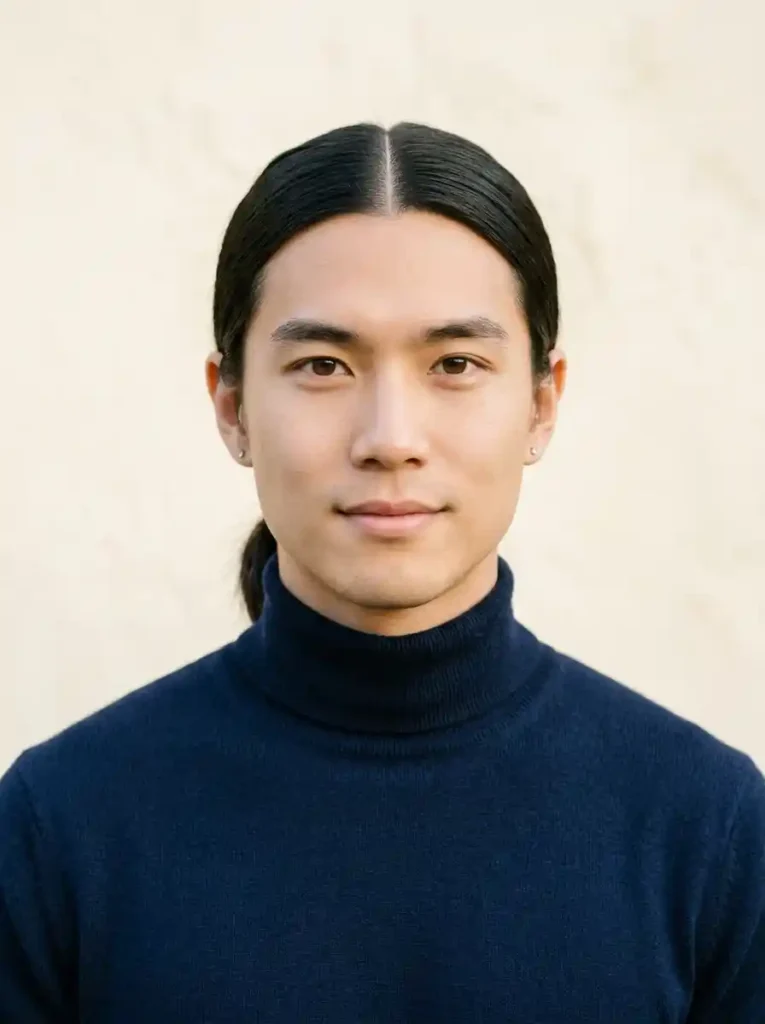
The center part ponytail is a specific aesthetic that has developed significant cultural momentum through Korean men’s fashion and international men’s grooming content — the precise center parting creating a geometrically symmetrical sweep from each side of the forehead back to the gathered ponytail, generating a balanced bilateral silhouette that reads as both mathematically satisfying and genuinely modern. The center part changes how the face is framed compared to a simple brushed-back ponytail, creating a more deliberate, considered quality that suggests the wearer thought about the geometry of their hairstyle rather than simply pulling it back and calling it done.
Achieving the clean center part requires a fine-tooth comb and slightly damp or product-assisted hair that accepts direction without fighting the parting — comb the part from hairline to crown with one deliberate stroke, using your finger to establish the part line before the comb follows it, then smooth each side backward before gathering both sections together at the ponytail base. The part must be genuinely central rather than slightly off-center to achieve the symmetric quality that makes this style visually satisfying — use a mirror or photograph from the front to verify the placement before committing. Men with oval or longer face shapes find the center part particularly flattering because the bilateral symmetry works harmoniously with those face shapes’ natural proportions.
9. The Wrapped Ponytail — The Detail That Elevates Everything
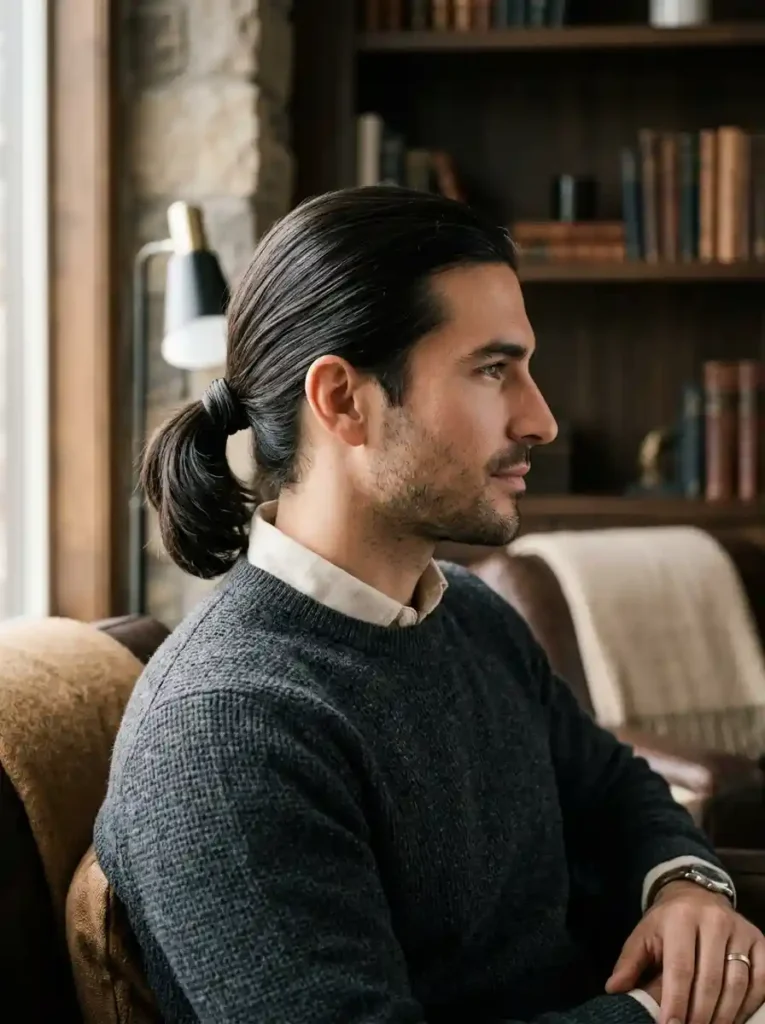
The hair-wrapped ponytail is the single detail that transforms a good ponytail into a great one — taking a small section of hair from the underside of the ponytail and wrapping it neatly around the elastic to conceal it completely, replacing the visible rubber band with a smooth band of hair that creates a distinctly polished, intentional quality at the ponytail base. It’s the kind of detail that makes people look twice without being able to immediately identify why your ponytail looks more refined than a standard one — the absence of the visible elastic is the difference that registers below conscious awareness but consistently influences how the overall style is perceived.
Wrapping is technically straightforward once practiced a few times — secure the main ponytail with an elastic, then take a thin section from the underside of the ponytail, wrap it tightly and smoothly around the elastic base in overlapping layers, and secure the end with a discreet bobby pin pressed flush against the wrapping. A small amount of light-hold hairspray applied over the wrapped section keeps it smooth and tight throughout the day without slipping. This detail takes approximately forty additional seconds to execute and adds a level of finish to the ponytail that communicates genuine grooming sophistication — the kind of care that most men haven’t thought to apply to a hairstyle they consider purely functional rather than stylistic.
10. The Ponytail With Beard — The Complete Masculine Composition
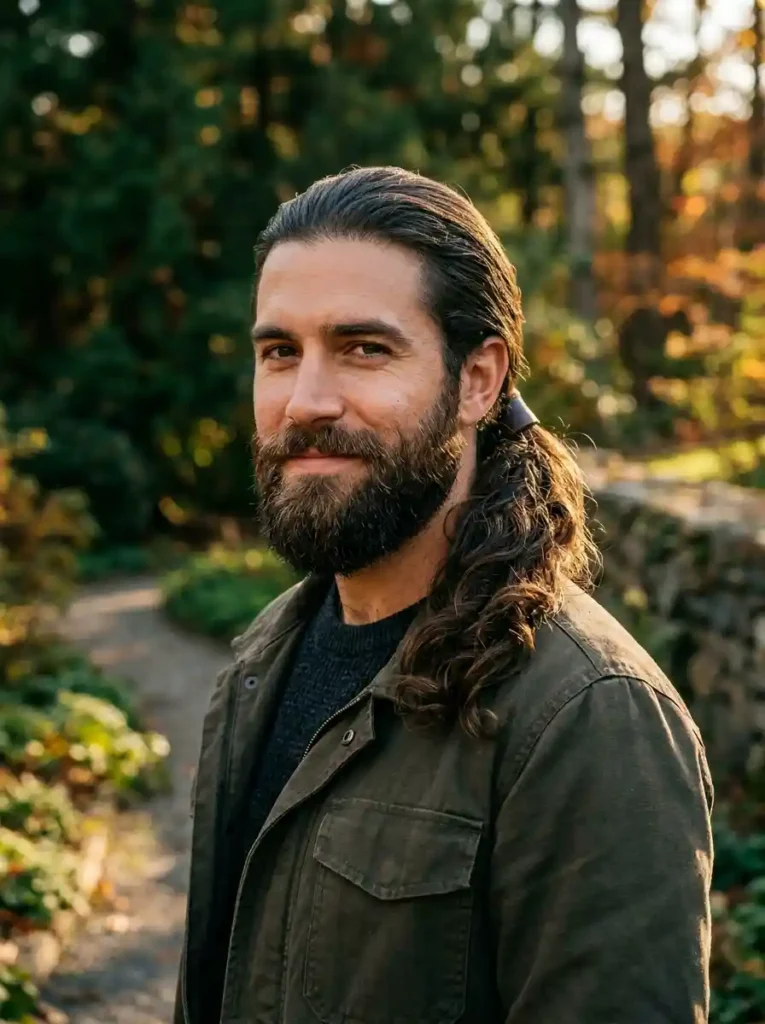
The mens ponytail paired with a well-maintained beard is one of those grooming combinations where the whole is genuinely greater than the sum of its parts — each element strengthens the visual impact of the other in a way that creates a complete masculine aesthetic composition rather than two independent styling choices coincidentally occupying the same face and head. The ponytail emphasizes the neck and jaw, directing the eye downward toward the face, while the beard provides the textural and structural grounding at the jaw that prevents the combined look from reading as simply having a lot of hair and facial hair simultaneously. The interplay between the two creates a cohesive masculine presence.
The key to making the ponytail and beard combination work harmoniously is scale consideration — a full, voluminous ponytail pairs best with a medium to full beard that provides visual balance in the lower face, while a more modest or tightly gathered ponytail works well with shorter, designer stubble that doesn’t compete for visual dominance. Both elements should receive equivalent quality of care — the same conditioning investment in the ponytail hair should be matched by a daily beard oil and balm routine that keeps the beard soft, healthy, and visually consistent with the well-maintained hair above it. Inconsistency in grooming quality between the two elements is immediately noticeable and undermines the cohesive impression that makes the combination so compelling when done well.
11. The Samurai-Inspired Topknot Ponytail — Ancient Tradition, Modern Confidence
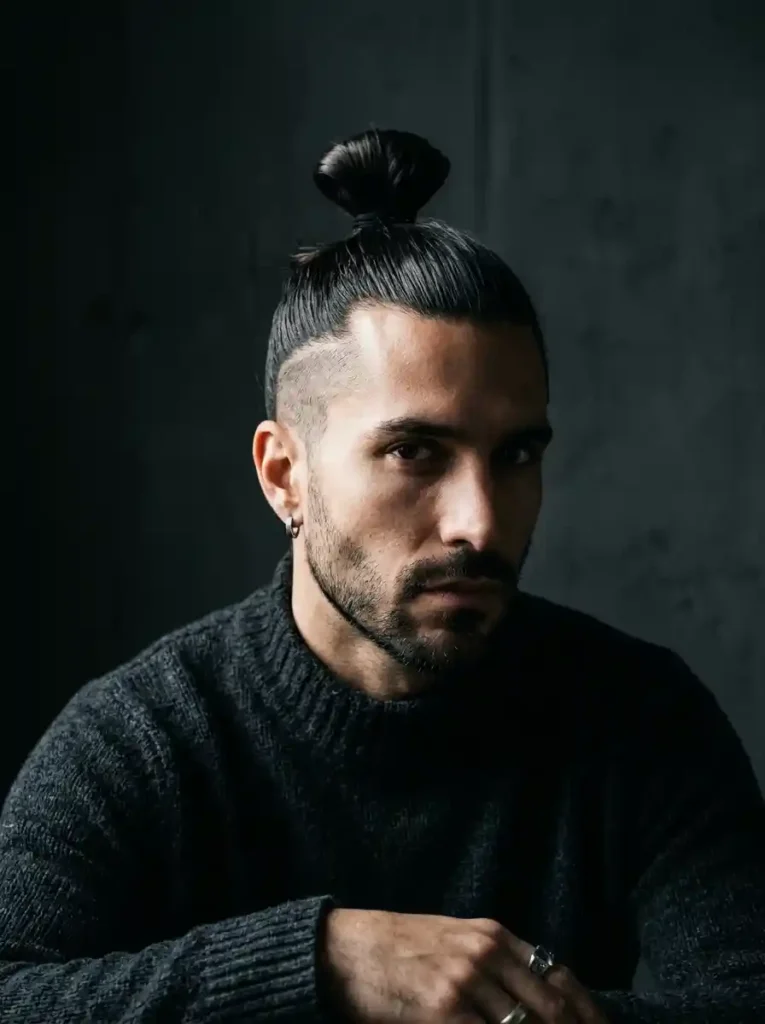
The samurai-inspired topknot is the men’s ponytail style with the deepest and most dramatically resonant cultural history — the chonmage worn by samurai warriors in feudal Japan was a specific signal of social status, martial dedication, and personal honor that made the hairstyle inseparable from the values it represented. Contemporary men wearing a high, tightly gathered topknot aren’t necessarily referencing that specific history consciously, but the style carries enough of that cultural weight to give it a gravitas and intentionality that other ponytail placements don’t quite possess. Worn with genuine confidence, it communicates something about personal conviction and comfort with unconventional masculinity.
The topknot requires sufficient length at the crown — at least six to eight inches of hair to create a clean, tight gather that doesn’t slip or loosen throughout the day — and the nape and sides should be naturally clean or freshly tapered to provide the contrast that allows the topknot’s placement to read clearly against the shorter surrounding area. Use a strong elastic for the secure gathering that this high-tension placement demands, and wrap with a second band or a hair-wrapped section to prevent the loosening that comes from constant movement throughout the day. Men who maintain this style long-term develop the specific confidence that comes from wearing something genuinely distinctive every single day without needing anyone else’s validation of the choice.
12. The Half-Up Ponytail — The Best of Both Options
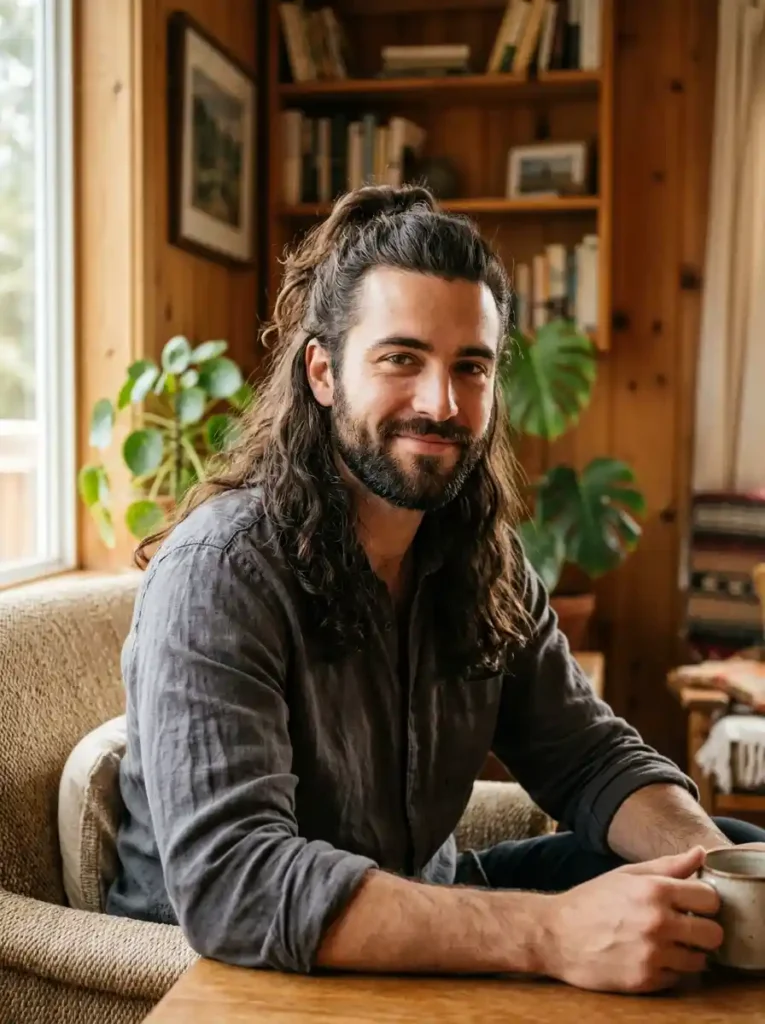
The half-up ponytail for men is the style that resolves the fundamental tension between wanting the face-clearing, heat-managing convenience of a gathered style and the visual impact of long hair worn fully loose — by splitting the difference and gathering only the top section while allowing the remaining lower half to fall freely, it achieves both simultaneously. The gathered top section keeps hair out of the face and creates an intentional styling gesture, while the loose lower half provides all the movement, texture, and visual presence of fully down long hair. It’s the style that photographs beautifully from every angle because there’s always something interesting happening at both the crown and the shoulders.
The half-up works particularly well for men with naturally wavy or textured hair because the contrast between the gathered section and the loose falling lengths highlights the natural texture of both portions — the gathered section shows the texture pulling back from the face, while the loose lower section shows the full natural movement and wave character. Gather the top section loosely rather than pulling it taut, using a seamless elastic or even a single pin for the most casual version, and allow a few pieces to fall forward at the temples from the gathered section to maintain the soft, unfussy quality that makes this style look genuinely lived-in rather than laboriously constructed.
13. The Ponytail With Hair Accessories — Personal Style Made Visible
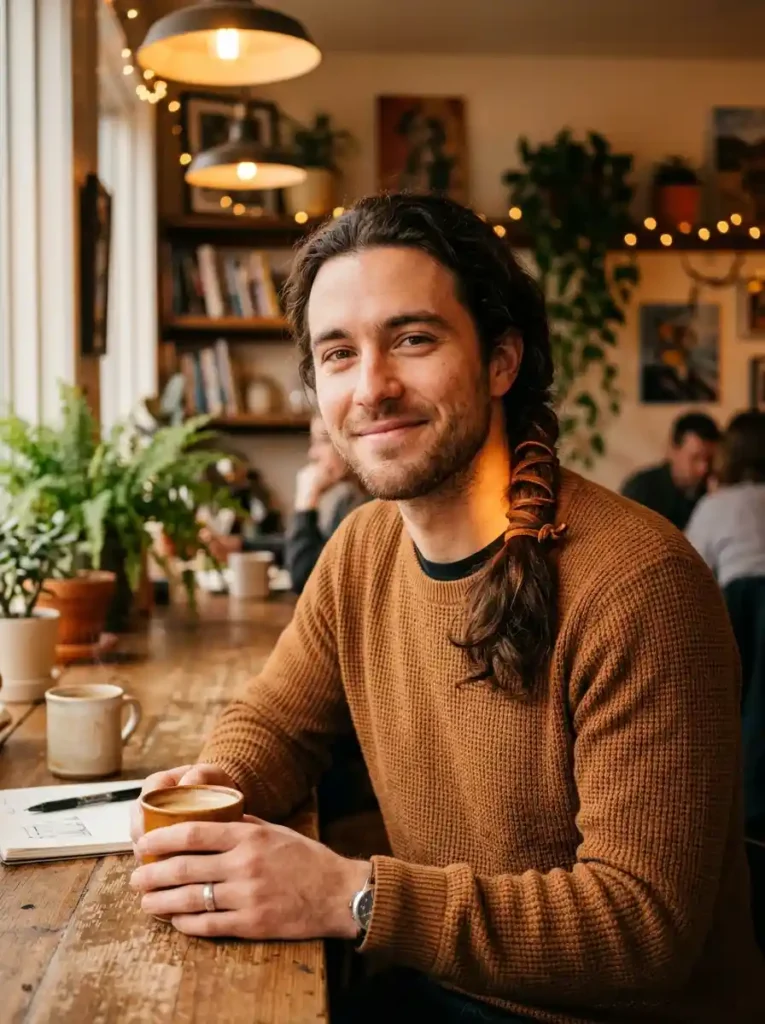
Adding a deliberate hair accessory to a mens ponytail hairstyle is one of the most personal and understated forms of self-expression available in men’s grooming — because the specific choice of accessory communicates something precise about aesthetic sensibility, cultural reference points, and personal values in a way that has genuine depth and character without requiring any explanation. A leather cord wrapped around the base references craftsmanship and natural materials; a wooden or carved bead adds cultural connection; a metal cuff or ring brings an industrial or architectural aesthetic; a simple silk cord adds refined elegance that references global textile traditions. Each choice says something specific.
The accessory should feel genuinely chosen rather than simply added — it should relate to other elements of your personal style in the same way that a watch, a ring, or a bracelet relates to the overall composition of what you’re wearing. Natural materials like leather, wood, and cord tend to work most cohesively with the organic, textural quality of hair regardless of the specific style being worn, while metal accessories suit sleeker, more polished ponytail variations that share a similar material aesthetic. The most compelling accessorized ponytails are those where the detail looks like it has always belonged there — not a deliberate styling decision, but an inevitable expression of a coherent personal aesthetic that extends naturally from every other style choice the wearer makes.
14. The Athletic Ponytail — High Performance Meets High Style

The athletic ponytail worn as a deliberate style choice rather than a purely functional compromise represents a specific and compelling masculine aesthetic — the association between long hair gathered for physical activity and athleticism has genuinely deep roots in both sporting culture and various historical warrior traditions, and wearing a clean, firm ponytail during physical activity or as part of an active lifestyle look carries that visual resonance into contemporary style contexts naturally and authentically. The functional clarity of a high, firm athletic ponytail has its own visual language that communicates physical capability, discipline, and the specific confidence of someone comfortable in their body.
The athletic ponytail requires a strong, fabric-covered elastic that maintains its hold through sweat and movement without slipping downward during training — avoid standard thin elastics that cut into the hair under tension and cause breakage at the gathering point over time with repeated athletic use. The placement at the crown or slightly above creates the most movement-stable position and the most aerodynamically sensible silhouette for physical activity. Many men who begin wearing the athletic ponytail purely for functional reasons discover that it becomes their preferred daily style regardless of activity level — the clean face-clearing quality and the physical confidence it projects translate naturally from the gym to everyday life.
15. The Low Ponytail With Side Sweep — Directional Movement That Flatters
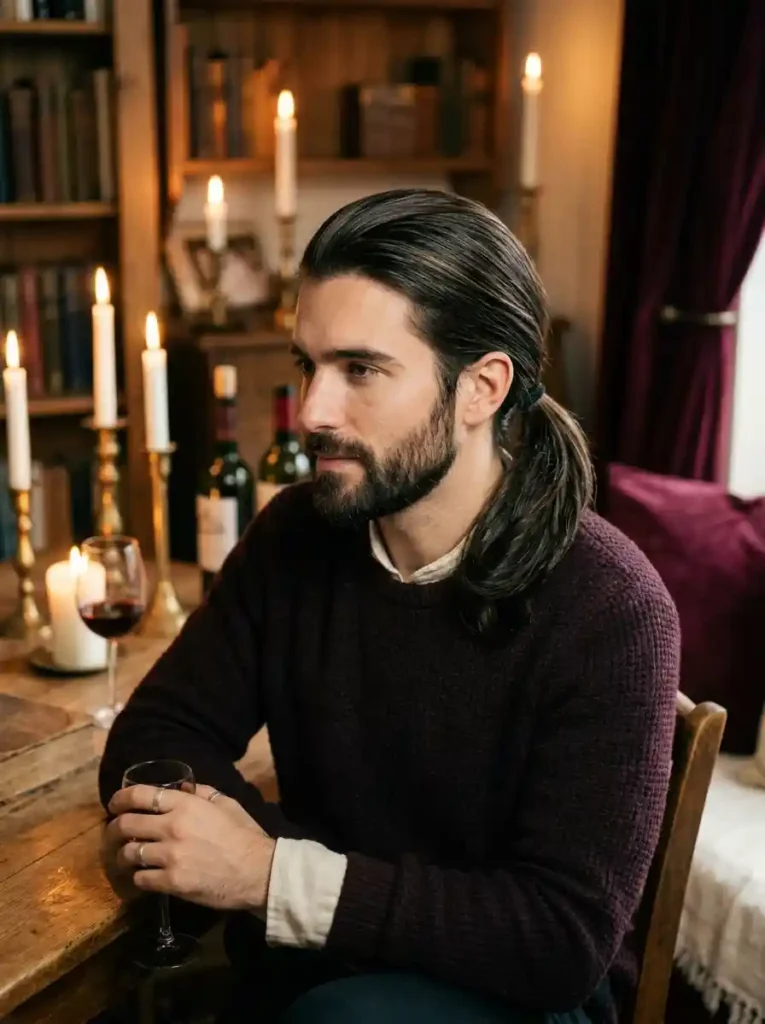
The side-swept low ponytail creates directional movement by gathering the hair slightly off-center rather than at the exact back center of the head, allowing the sweep of hair from the opposite side to create a graceful diagonal line across the back of the head before meeting the ponytail base. It’s a subtler variation than it sounds — the asymmetry is gentle rather than dramatic, creating a more interesting visual quality than a perfectly centered ponytail while remaining well within the range of styles that work across professional and social contexts without requiring any particular boldness or conviction to wear comfortably.
The side sweep works most beautifully on straight to slightly wavy hair at medium to medium-long length, where the directional movement has enough length to create a visible sweep without enough wave to disrupt the clean diagonal line that makes the style’s character. Part the hair with a soft side part before gathering rather than brushing everything straight back — this establishes the directional sweep naturally from the parting rather than forcing it artificially from a centered starting position. The off-center positioning of the ponytail base adds a small but meaningfully flattering asymmetry to the overall head shape that photographs well from the back and side profile angles that standard centered ponytails sometimes don’t address as interestingly.
16. The Braided Ponytail — Texture and Craft Combined
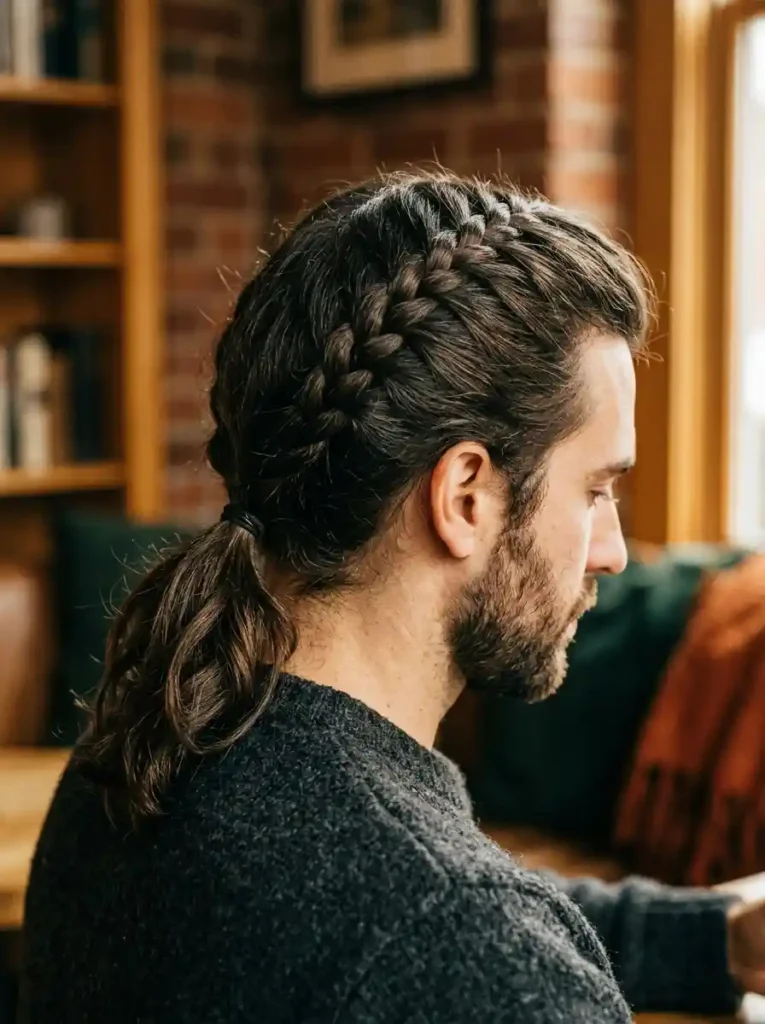
The braided ponytail combines two separate hair styling traditions into a single composition that has more visual interest and craft complexity than either element achieves independently — the braid running from the hairline or crown down to the ponytail base adds a structured, geometric texture element that transforms the simple backward sweep of a conventional ponytail into something that requires and demonstrates genuine hair handling skill. The transition point where the braid releases into the free-hanging ponytail below is a particularly beautiful detail that creates a natural, organic quality in the composition that purely constructed styles don’t achieve.
A simple three-strand braid running down the center back from crown to nape before releasing into the ponytail is the most accessible version — it requires basic braiding technique that most people can learn and execute competently with a few practice sessions. For men with longer hair, the braid can run the full length of the hair and the ponytail section can be secured at the very end where the braid naturally terminates, creating a fully braided ponytail rather than a partially braided one. Securing the braided section with a clear elastic before adding the outer ponytail elastic at the base prevents the braid from loosening during the day and maintains the clean geometric pattern from crown to transition point throughout an entire day of wear.
17. The Ponytail With Curtain Bangs — The Face-Framing Combination

Curtain bangs paired with a low ponytail create one of the most photographically interesting men’s hairstyle combinations currently circulating on Pinterest and men’s grooming content — the soft, face-framing pieces at the front create visual intimacy and dimension around the face while the clean gathered ponytail behind provides structural contrast that prevents the overall look from becoming too soft or undefined. The center-parted curtain bangs falling to either side of the face create a natural frame that changes how the entire face reads, adding a warmth and approachability that pulling everything completely back in a plain ponytail doesn’t quite achieve.
The curtain bangs need enough length to fall at least to the brow or slightly past it to create the characteristic framing effect — too short and they simply become short layers that don’t achieve the curtain quality, too long and they fall past the cheekbone and lose the forehead-framing that makes the combination with the ponytail so effective. Style the curtain bangs by applying a light texturizing cream while slightly damp and allowing them to air dry in their natural parting direction, then gather the remaining hair into the ponytail separately. The contrast between the softly textured, slightly wispy curtain bangs at the front and the clean gathered ponytail at the back creates a layered, multidimensional quality that rewards viewing from every angle.
18. The Long Wavy Ponytail — Maximum Hair Impact Beautifully Gathered
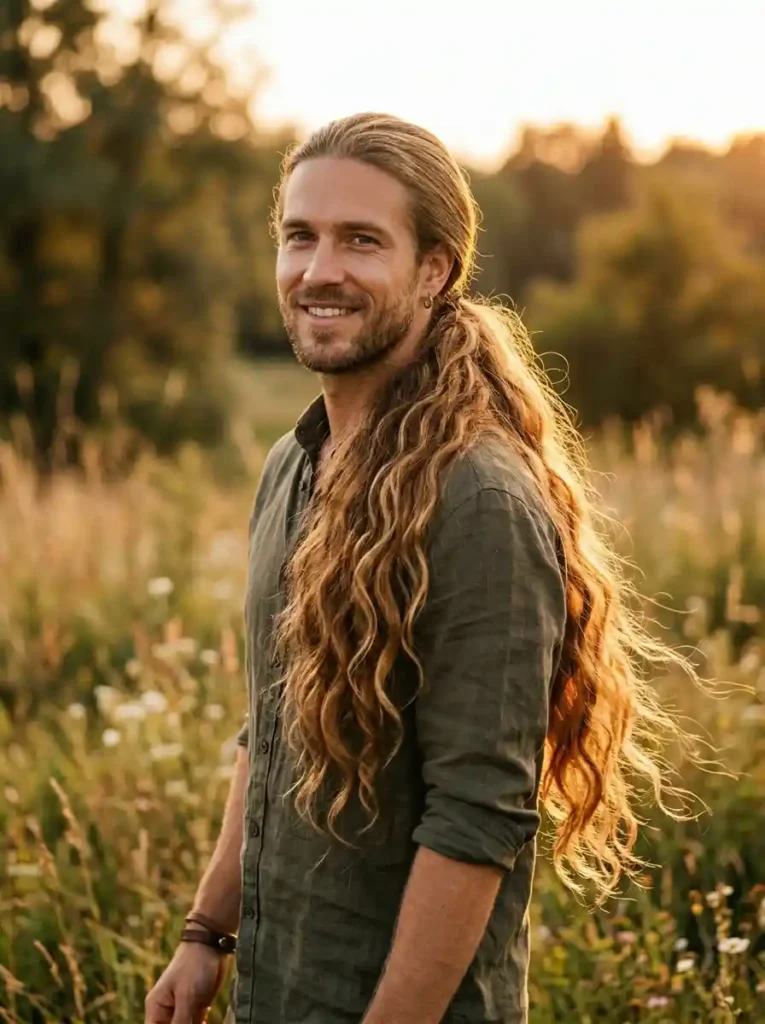
The long wavy ponytail is the style that rewards patience above everything else — years of growth, consistent conditioning, heat protection, and protective styling that culminate in a ponytail of length and natural wave quality that commands genuine attention when it moves. This is the mens ponytail hairstyle that turns heads in the most literal sense — the movement of genuinely long, naturally wavy hair gathered into a low ponytail creates a visual impact that shorter or straighter versions simply cannot replicate with the same natural drama. Every strand that falls past the shoulders adds to the collective impression of extraordinary hair worn by a man completely comfortable with its length and character.
Maintaining hair long enough for this style requires a disciplined care routine that prioritizes moisture, protection, and minimal mechanical damage at every stage — deep conditioning treatments every two weeks, heat protectant before any tool use, gentle detangling starting from the ends and working upward, and trimming split ends every six to eight weeks to prevent breakage that would compromise the length growth process. The ponytail elastic placement deserves particular attention at this length — position it slightly looser than feels necessary and use a seamless, fabric-covered elastic rather than a standard rubber band to prevent the chronic breakage that accumulated elastic tension causes at the gathering point in longer, heavier hair over months of daily wearing.
19. The Ponytail With Natural Locs — Heritage and Personal Expression
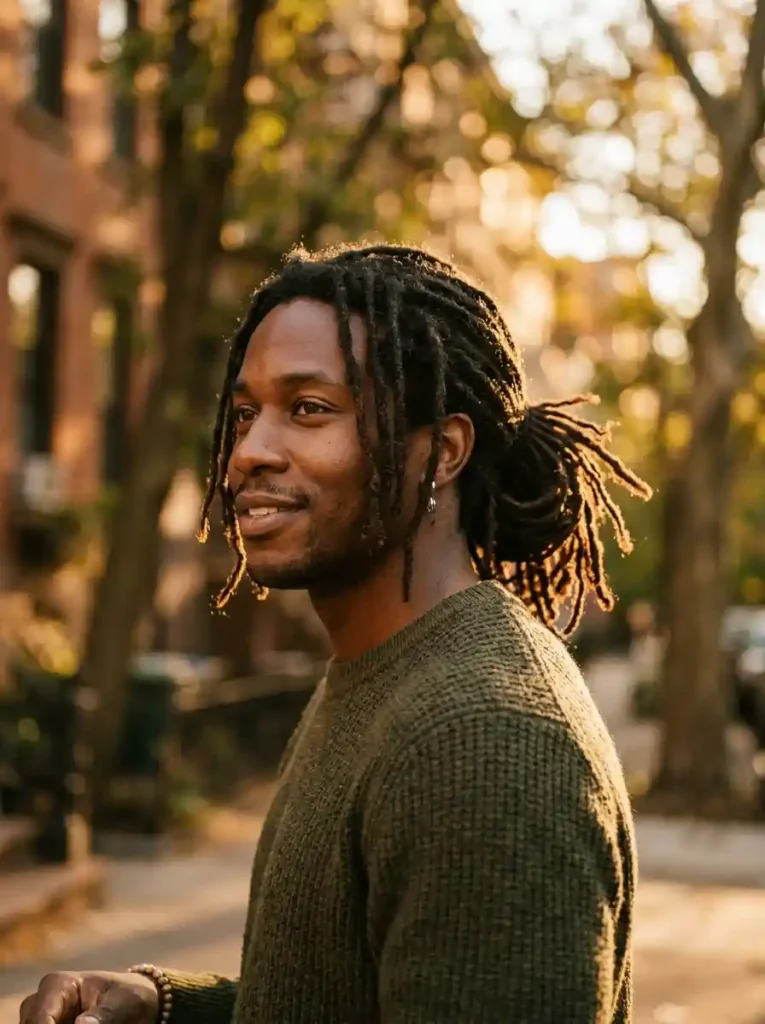
Natural locs gathered into a ponytail create a hairstyle composition with both extraordinary visual texture and profound cultural depth — when the locs are at medium length and gathered loosely at the nape or low on the head with some individual locs escaping to frame the face, the style has a relaxed, lived-in quality that communicates both genuine personal care and complete ease with one’s own natural hair heritage. Each loc catching light at a slightly different angle creates the kind of multidimensional texture composition that makes the gathered style look more visually rich and interesting than any other hair type in the same ponytail position.
The care that goes into maintaining locs healthy enough to wear this way is significant and forms its own meaningful daily practice — regular scalp moisturizing, retwisting new growth every three to four weeks, and protective sleeping habits that prevent the friction-based frizz and matting that undermine loc definition over time. Locs gather naturally for a ponytail but benefit from a large, seamless elastic that accommodates their individual diameter without creating the pressure that standard small elastics exert on cylindrical loc structures. Men who grow and maintain their natural locs to ponytail length discover they’ve created something genuinely extraordinary — a hairstyle that carries cultural heritage, personal history, and individual character in equal and inseparable measure.
20. The Slicked-Back Gel Ponytail — Wet-Look Drama
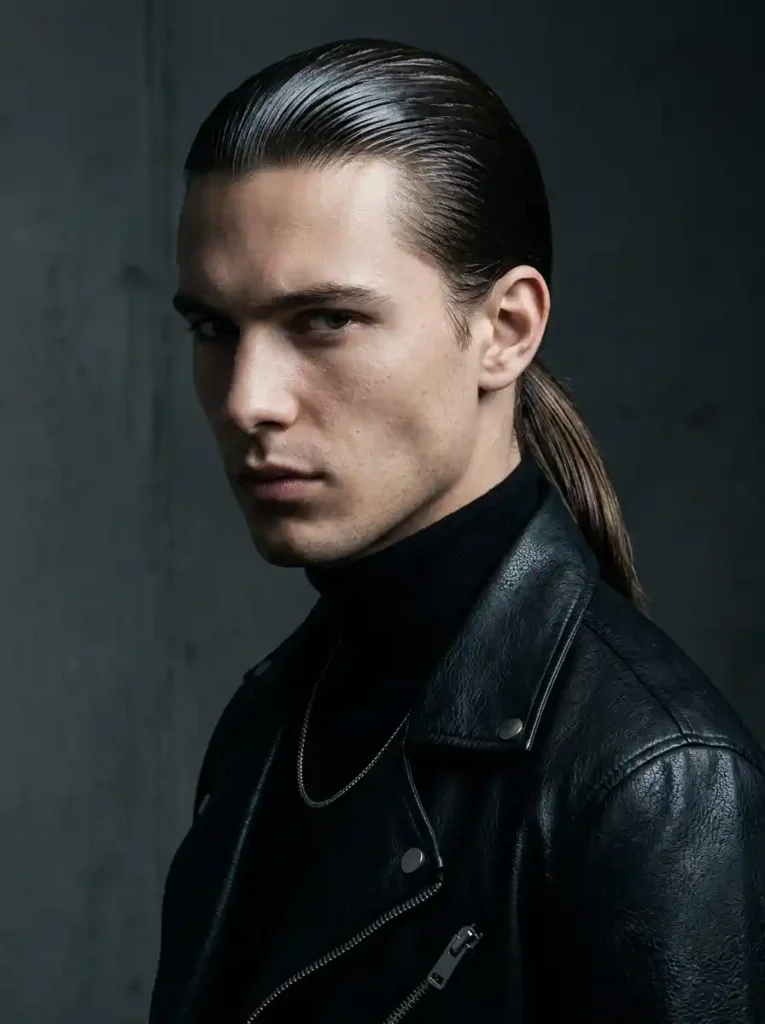
The slicked-back wet-look ponytail is men’s high-fashion grooming at its most dramatically committed — every strand plastered completely flat and smooth against the scalp from hairline to ponytail base with a strong-hold gel or pomade that creates a lacquered, almost sculptural surface quality that reads unmistakably as a deliberate editorial style choice. This is not an everyday style for most men, but as an occasional expression of grooming ambition — for a significant event, a creative occasion, or simply a moment when you want your hair to make a statement that nothing else in your wardrobe quite matches — it delivers extraordinary visual impact with complete certainty.
The product application process requires thoroughness — apply a strong-hold gel to damp hair and comb through completely with a fine-toothed comb to ensure even distribution from roots to ends before gathering into the ponytail. Any section that receives insufficient product will dry naturally rather than slicked and will create a visible inconsistency in the smooth surface that undermines the entire aesthetic. Gather the slicked hair while still damp so the gel sets in the gathered direction rather than fighting the product after it has already partially dried. The wet-look finish lasts through the day but requires thorough washing in the evening to prevent product buildup that would make the next morning’s styling significantly more difficult.
21. The Grow-Out Ponytail — The Beautiful Journey Phase
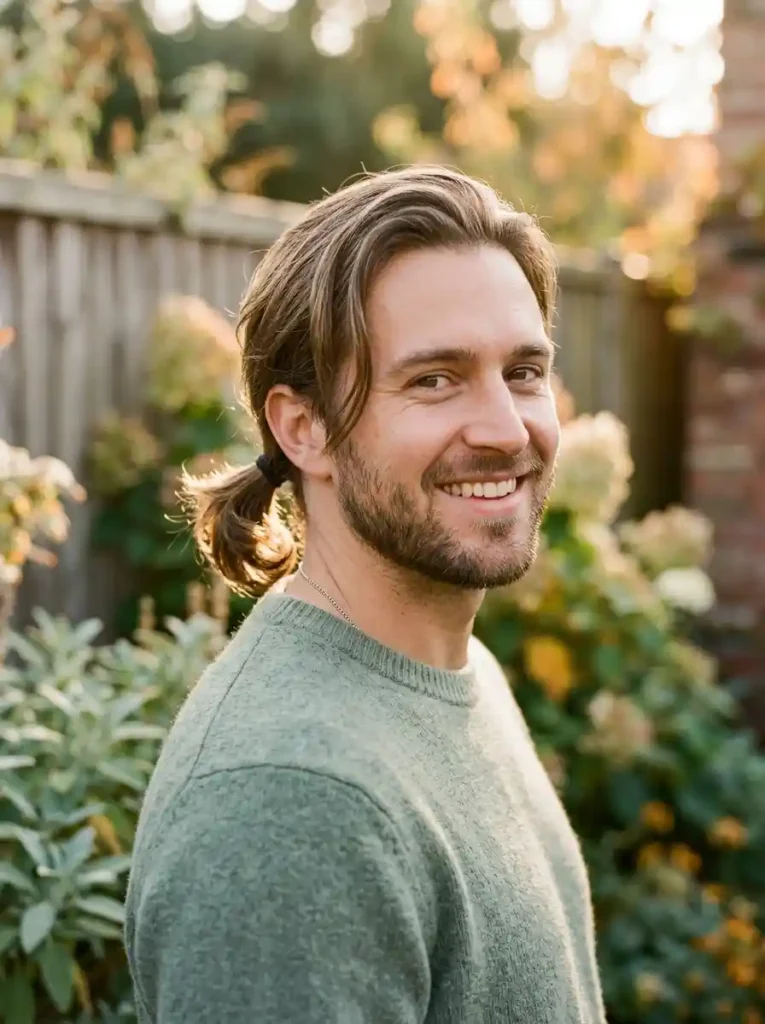
The grow-out ponytail is the style that belongs to the most honest and relatable part of the long hair journey — the phase where you finally have just enough length to gather back into a small, slightly imperfect ponytail that might not hold perfectly and might include shorter layers at the front that don’t quite reach the elastic yet, but is undeniably, genuinely a ponytail. This stage is worth celebrating rather than simply tolerating as an obstacle between short hair and long hair — it represents the successful navigation of every awkward in-between phase, and wearing the small grow-out ponytail with genuine confidence rather than apologetically is the specific attitude that makes it look intentional rather than accidental.
The grow-out phase benefits enormously from regular trims every six to eight weeks that remove split ends without cutting length — the temptation to skip trims during active growth in order to preserve every millimeter of length actually results in slower apparent progress because split ends travel up the hair shaft and cause breakage that removes the length you were protecting. Use a strong elastic with a small diameter that can gather the shorter ponytail securely, apply a light gel or pomade to smooth the shorter layers that don’t quite reach the gathering point, and remember that every morning you wear this ponytail is a morning you’re visibly closer to the longer style that motivated the decision to grow in the first place — that momentum is its own quiet, genuine confidence.
Conclusion
Mens ponytail hairstyles prove that long hair can be just as versatile, masculine, and stylish as any short haircut. From sleek low ponytails and modern undercuts to textured waves and rugged topknots, each variation offers a unique way to express confidence and personal style. The beauty of the ponytail lies in its adaptability—it works across different hair types, lengths, and lifestyles while allowing endless room for individuality. Whether you’re just entering the grow-out phase or have worn long hair for years, the right ponytail can elevate your entire look. Wear it with confidence, maintain healthy hair, and make it your own.