Long hair on men has never carried more cultural momentum than it does right now, and at the center of that conversation sits the top knot, a style that pulls the hair upward into a gathered knot at the crown and frames everything below it with quiet authority. The top knot is not a new idea, it has roots in Japanese warrior culture, South Asian tradition, and countless historical contexts where long hair worn up was associated with strength and identity rather than informality or trend-following. What has changed is the context in which contemporary men are wearing it, and the extraordinary range of textures, hair types, and personal aesthetics that the style now accommodates. From a tightly wound high knot worn over a skin fade to a loose, casual top knot worn with a full beard on a relaxed weekend, this style adapts to the man wearing it with remarkable versatility. Whether your hair is straight, wavy, curly, or coily, whether you are in a boardroom, a coffee shop, or a wedding venue, there is a version of the top knot that suits you entirely. The twenty-one styles in this collection prove that the top knot is not a trend you wait out. It is a hairstyle you grow into and wear with complete conviction.
1. The Classic High Top Knot
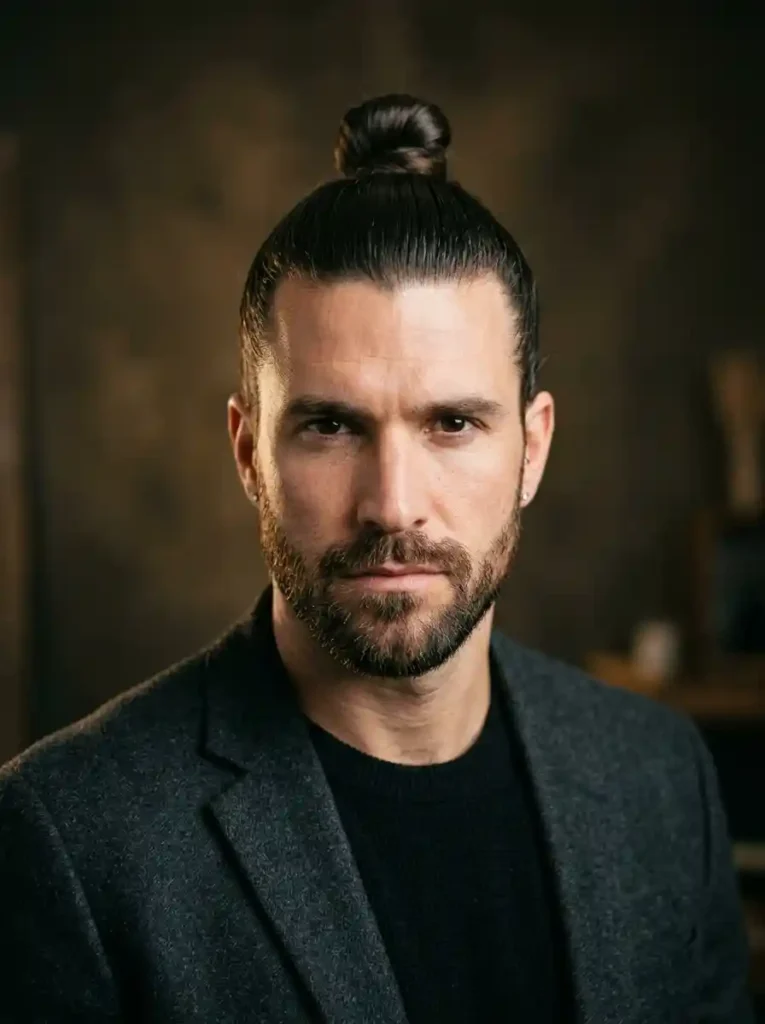
The classic high top knot is the purest and most recognizable expression of this style, and it earns its status through the sheer simplicity and strength of its silhouette. Every strand of hair is gathered upward from the nape, the sides, and the forehead into a single gathered point at the very crown of the head, where it is wrapped and secured into a clean, rounded knot. The result is a completely clean line from the face upward, which draws attention to the bone structure of the jaw and cheekbones while the knot itself sits like a deliberate crown above everything else.
The classic high top knot works best with hair that is at least four to six inches in length and has enough weight to lie smooth against the head during the gathering process. Straight and wavy hair types tend to achieve the cleanest, most symmetrical version of this style, though men with fine hair can use a light smoothing serum to reduce flyaways and achieve a similar result. Securing the knot with a fabric hair tie rather than a rubber band prevents breakage at the gathering point, which is particularly important for men who wear this style daily. A clean neckline and smooth temples complete the look.
2. The Messy Top Knot
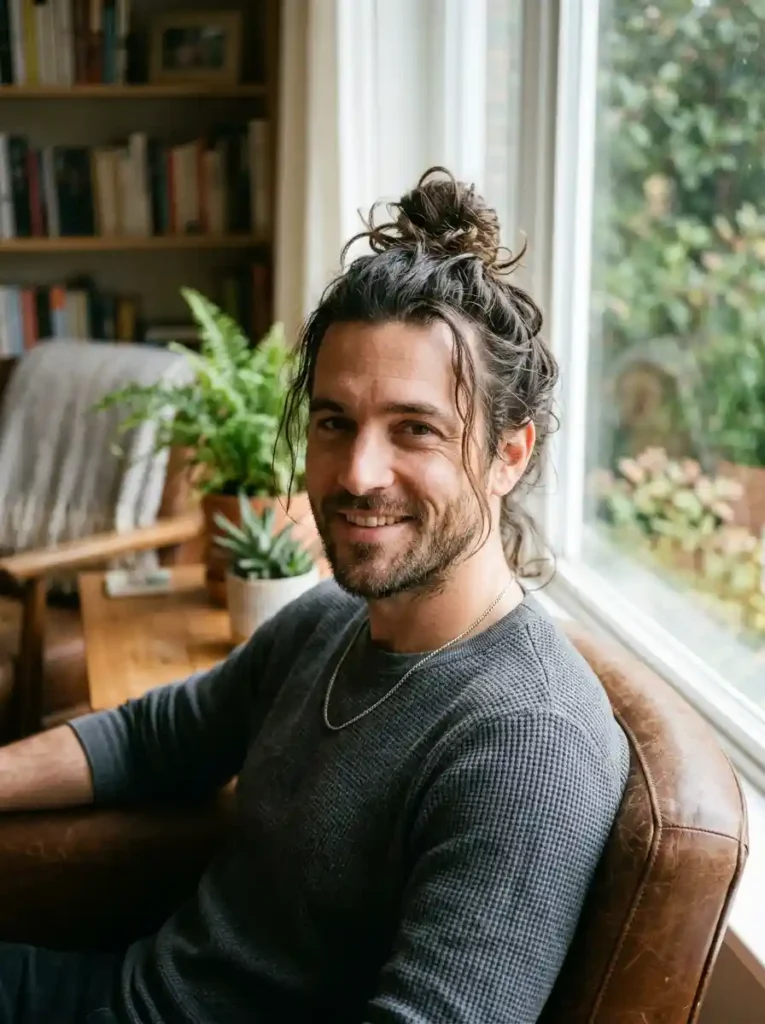
The messy top knot sits at the opposite end of the spectrum from the classic high version and occupies a space in men’s grooming that is entirely its own. The hair is gathered loosely upward without the intention of achieving a perfect, smooth surface, and the knot is formed with a casual wrap and tuck that deliberately leaves loose strands around the face, at the temples, and at the nape. This imperfection is the point. The style communicates ease, confidence, and the kind of personal security that comes from not needing everything to be architecturally precise.
What makes the messy top knot look genuinely stylish rather than simply unkempt is the quality and condition of the hair itself. Well-moisturized, healthy hair that happens to be gathered loosely looks intentionally casual. Dry, neglected hair gathered loosely looks like someone gave up. A small amount of a texturizing product or a light hair oil applied before gathering the hair adds definition to the loose strands and gives the overall impression of a man who knows exactly what he is doing, even when the style suggests he did it in thirty seconds without looking in a mirror. Regular trims at the ends prevent split ends that would undermine the casual elegance of this approach.
3. The Top Knot with Undercut
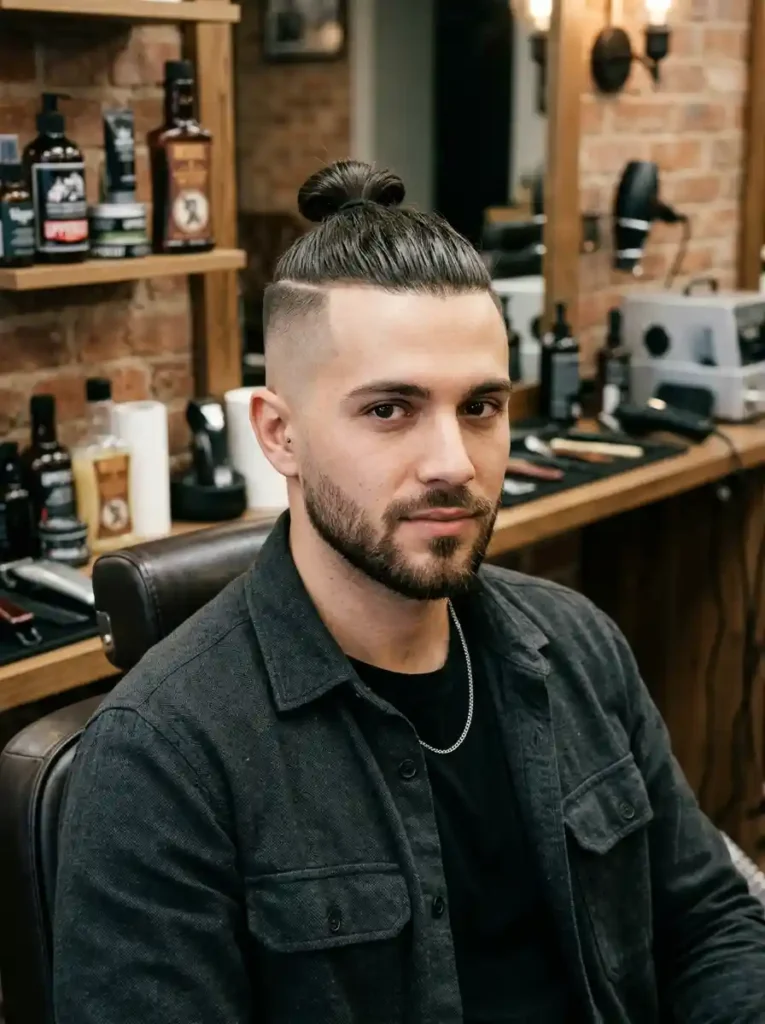
Pairing a top knot with an undercut is one of the most dramatic and visually effective combinations in contemporary men’s hairstyling. The undercut shaves or closely clips the hair at the sides and back up to a defined line, creating a stark contrast between the very short, faded sides and the longer hair on top that is gathered into the knot. When the hair is worn up in the top knot, the undercut is fully revealed and the silhouette is architectural and sharp. When the hair is worn down, the undercut remains as a hidden layer of contrast beneath the longer top section.
This dual personality is one of the primary appeals of the top knot undercut combination. It offers two completely different looks from a single haircut, with the decision of up or down making an enormous difference in the overall impression. The disconnection between the very short sides and the full top section becomes even more dramatic in the context of a skin fade rather than a standard clipper undercut, as the skin fade creates a completely seamless transition from bare scalp to hair that makes the gathered knot appear almost to float above the head. Regular barber visits maintain the fade while the top section continues growing toward the desired knot length.
4. The Top Knot with Full Beard
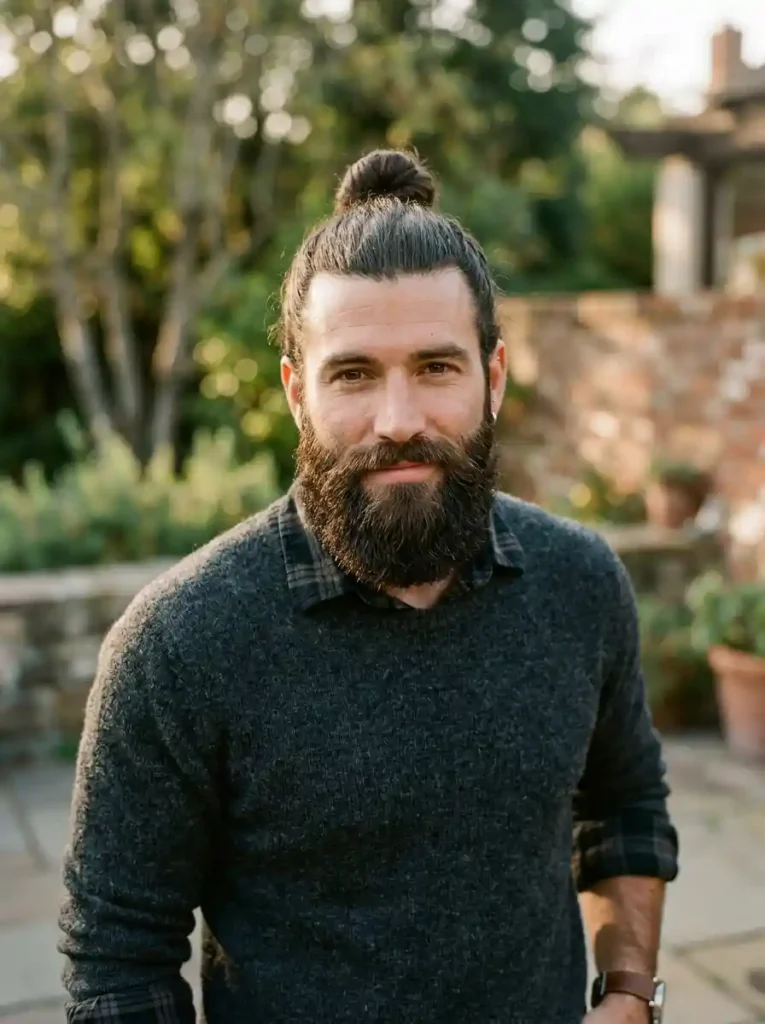
The combination of a top knot and a full beard is one of those pairings where both elements make each other better. The top knot draws the eye upward toward the crown, while the full beard anchors the face from below, and between those two strong visual elements, the face is framed in a way that emphasizes the eyes and the overall bone structure with unusual power. Men who wear both together are making a statement about personal style that is simultaneously bold and deeply masculine, and the combination reads as confident rather than costume-like when both elements are well-maintained.
The key to making this combination work aesthetically is ensuring that neither element looks neglected. A messy top knot works beautifully with a well-groomed beard, and a tight high knot can pair equally well with a more casual beard shape, but a haphazard knot alongside an untrimmed beard creates an impression of disorder rather than deliberate style. Regular beard conditioning, shaping, and trimming should be built into the same grooming routine as the top knot maintenance, and the two should be evaluated together in the mirror to ensure they form a coherent, intentional overall composition rather than two separate elements existing simultaneously on the same face.
5. The Half-Up Top Knot
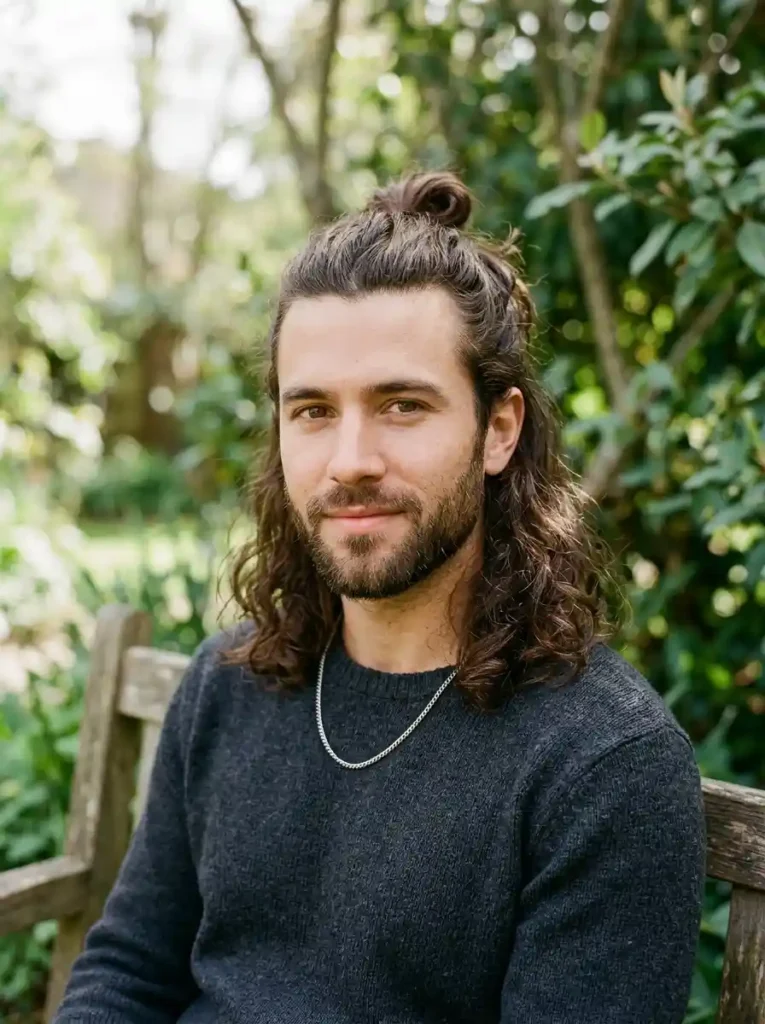
The half-up top knot takes only the upper section of the hair, the portion from the crown forward and to the sides, and gathers it into a knot while leaving the remaining hair at the back and lower portions loose. This creates a style that is less severe than a full top knot, offering the visual interest of the gathered knot with the softening effect of flowing hair below it. For men with longer hair who want a way to keep the hair off the face without fully committing to an updo, the half-up version is one of the most wearable and universally flattering interpretations available.
The position and size of the half-up knot can be adjusted to change the character of the style significantly. A small, neat knot positioned higher on the crown reads as more intentional and slightly formal, while a larger, looser knot placed further back reads as casual and relaxed. Men with wavy or curly hair find this style particularly effective because the texture of the loose lower section adds natural volume and movement that complements the gathered section above. A single hair tie or an elastic band is all the hardware required, and the style can be assembled and adjusted in under two minutes once the technique becomes familiar.
6. The Top Knot with Skin Fade
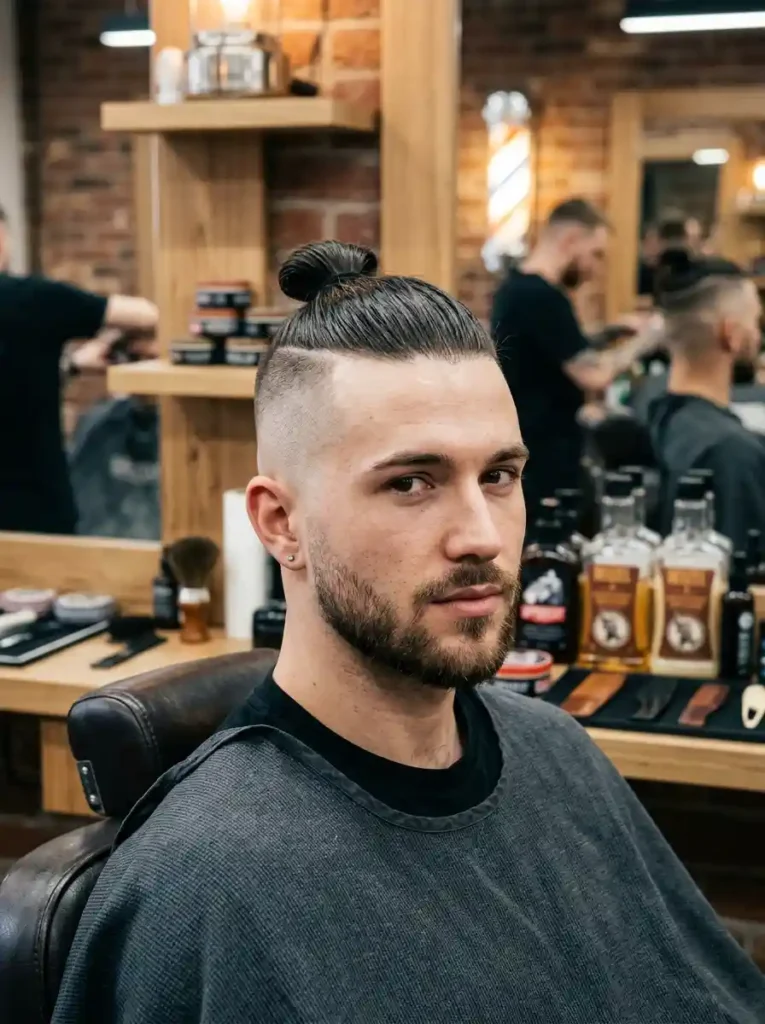
The skin fade top knot is perhaps the most polished and contemporary interpretation of the man bun aesthetic, taking the traditional Japanese-influenced samurai-style knot and framing it with the clean, modern precision of a barbershop skin fade. The fade begins at the skin at the bottom of the sides and back and builds smoothly upward toward the longer hair that forms the top knot, creating a gradient from absolute cleanness to full gathered volume that reads as both technically impressive and genuinely stylish. The contrast between the smooth faded skin and the structured knot creates a silhouette of unusual clarity and strength.
The skin fade top knot requires the regular attention of both a barber and a consistent personal grooming routine. The fade itself needs to be touched up every two to three weeks to maintain its clean gradient, as even a week of growth begins to soften the precision of a skin fade in a way that diminishes the dramatic contrast that makes this style so effective. The top section needs to be kept clean, conditioned, and free of split ends to look its best when gathered into the knot. Together these two maintenance commitments create a look that consistently draws positive attention and communicates a serious investment in personal appearance.
7. The Samurai Top Knot
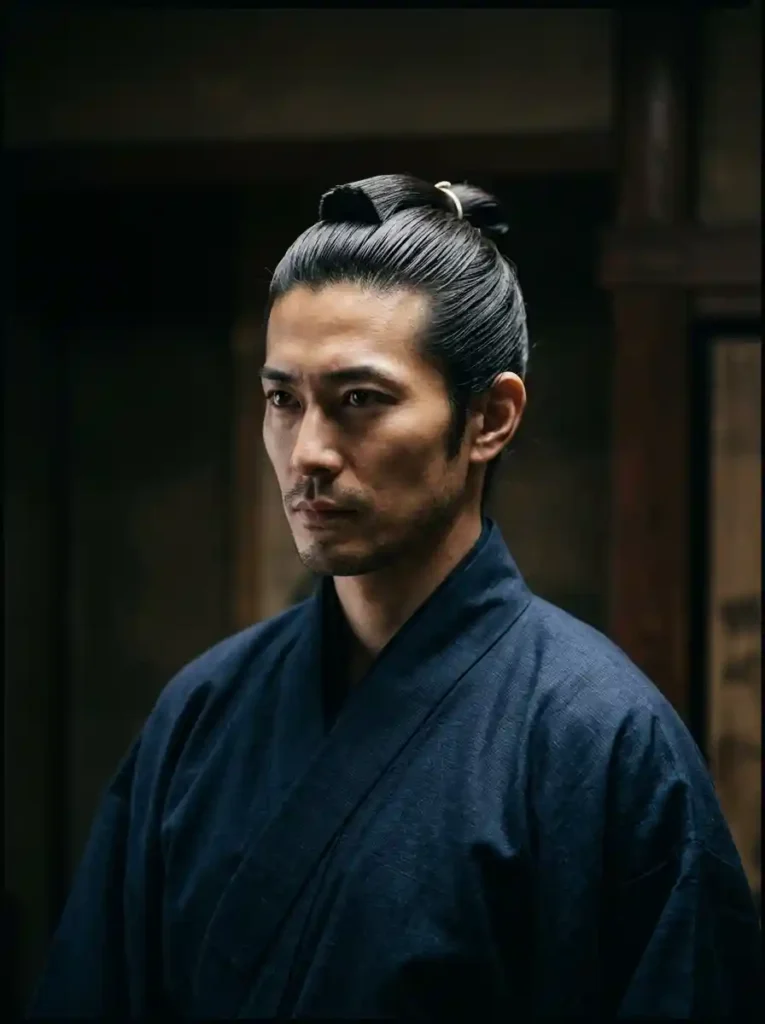
The samurai top knot draws directly from the historical chonmage of Japanese warriors and lords, and wearing a modern interpretation of this style is a way of connecting a contemporary grooming choice to a tradition of strength, discipline, and identity that stretches back centuries. The samurai knot tends to sit very cleanly at the crown, with the hair gathered tightly and folded or wound in a compact, structured shape rather than the rounded, looser form of a casual man bun. The tightness and precision of the knot give it a severity that communicates complete intentionality in the styling.
Men with straight or slightly wavy hair achieve the most historically accurate version of this style, as the clean lines of the gathered knot are easier to achieve with hair that lies smooth. However, men with other hair types can absolutely adapt the samurai aesthetic to their texture, using a smoothing cream or a light holding product to achieve a similar level of structural precision. The style pairs naturally with longer, more sculptural forms of dress and with facial hair that is either very clean-shaven or very deliberately grown. It reads at its strongest when the man wearing it carries himself with the quiet, upright confidence the original tradition implies.
8. The Loose Bun Top Knot
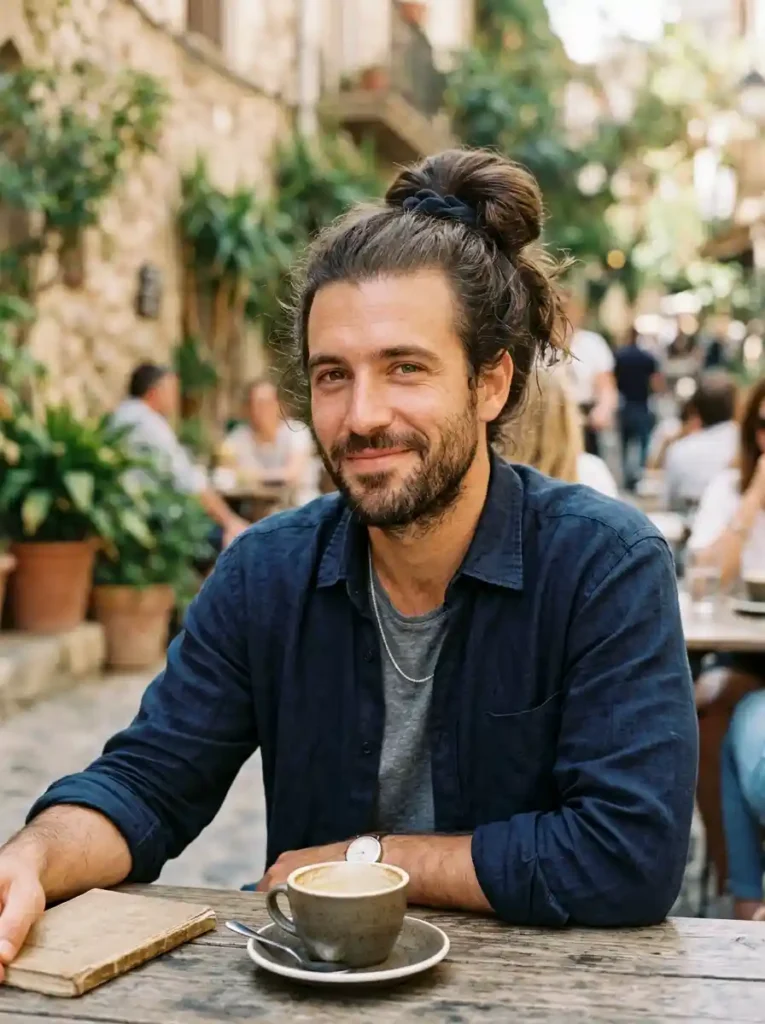
The loose bun top knot occupies the middle ground between the structured formality of a high tight knot and the deliberate dishevelment of a messy top knot. Here the hair is gathered with intention but allowed to sit with some natural volume in the bun itself, the wrapping creating a rounded shape that is softer and more organic than a tightly wound knot. The looseness at the bun allows the natural texture and weight of the hair to show through, creating a style that feels personal and authentic rather than rigidly styled.
This is the version of the top knot that the most men find themselves wearing on a regular basis once they have grown their hair to sufficient length, because it achieves the practical goals of keeping the hair off the face and neck while requiring very little time or effort to assemble. For men with wavy or naturally textured hair, the loose bun actually benefits from the slight irregularity that the wave pattern introduces, creating a bun with more dimension and visual interest than the same style on straight hair. The key maintenance requirement is regular conditioning to keep the hair healthy and flexible enough to gather easily without breaking.
9. The Top Knot with Curtain Bangs
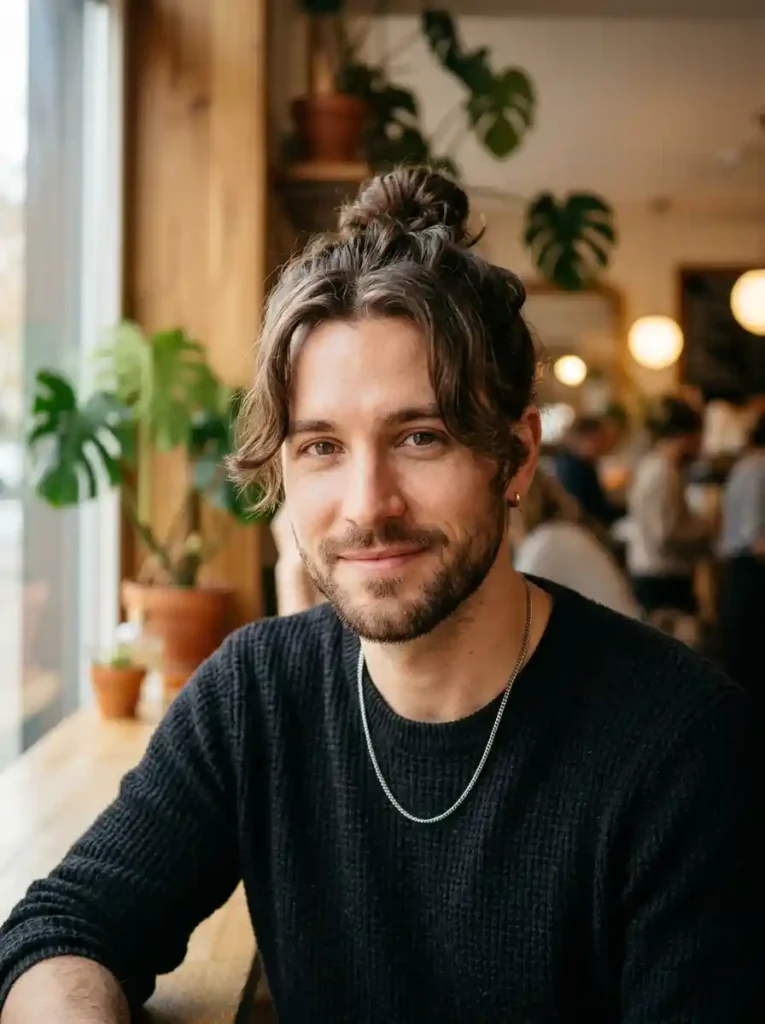
Leaving the front section of the hair out of the top knot and styling it into curtain bangs creates a style with an entirely different character from a fully gathered knot. The curtain bangs part at the center of the forehead and fall softly to either side, framing the face with movement and softness while the top knot holds the remaining hair up and away from the neck. The combination creates a profile that is simultaneously structured at the back and soft at the front, which gives the overall impression of a man who is thoughtful and deliberate about the way he presents himself.
This style works particularly well for men with hair that has enough length to reach a comfortable knot at the back while the front section remains long enough to form clear curtain bangs. The bangs themselves should be cut with a slight point at the center where they part, creating a natural direction of fall on each side. A light texturizing spray or a small amount of styling cream applied to the bang section helps the curtains hold their shape and direction without stiffness. The top knot at the back can be either tight or loose depending on the desired energy of the overall look.
10. The Top Knot with Natural Curls
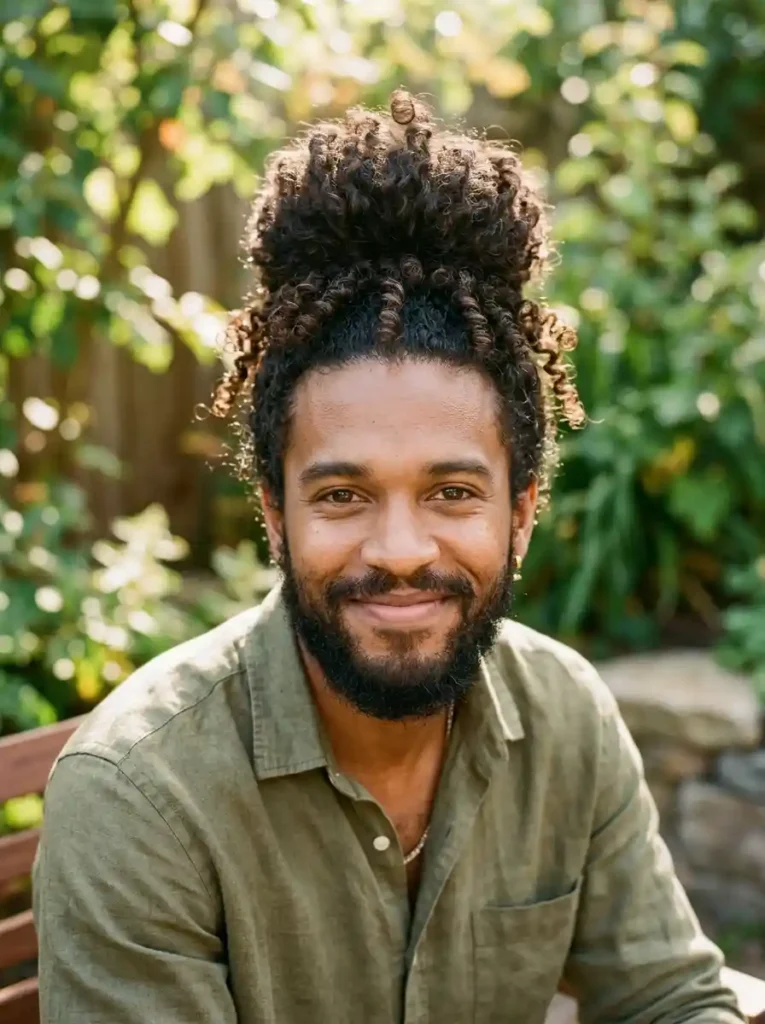
Natural curls introduce a completely different dimension to the top knot, adding volume, texture, and visual complexity to what is otherwise a simple gathering of hair at the crown. Men with natural curl patterns who grow their hair long enough for a top knot find that the gathered knot sits with a natural fullness that straight hair simply cannot replicate, and the curl texture peeking out around the gathering point and from the knot itself creates a style that looks abundant and characterful rather than flat or one-dimensional.
The challenge with a curly top knot is managing the gathering process in a way that protects the curl pattern rather than pulling it out. A satin or fabric-covered hair tie creates far less friction than a rubber band, which can disturb the curl pattern and cause frizz along the shaft of the hair at the gathering point. Gathering the hair when it is slightly damp and has a small amount of curl cream worked through it helps the curls stay defined as they are pulled upward into the knot. Men with very tight coil patterns should avoid pulling the hair too tightly at the scalp, as this can cause tension that is damaging over time.
11. The Top Knot with Fade and Design
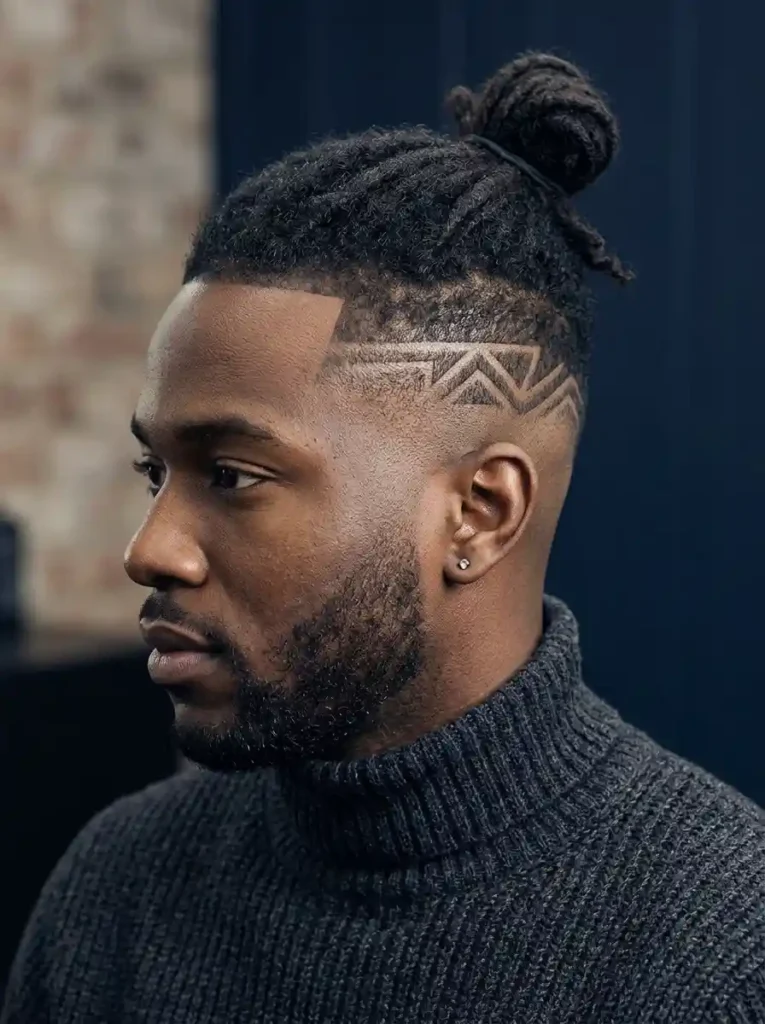
Adding a shaved design element to the faded sides of a top knot with fade creates a style that operates at the intersection of barbering art and personal expression. The design, whether it is a geometric line, an angular pattern, or a more elaborate artistic element etched into the faded skin at the temple, adds a layer of customization that makes the cut entirely specific to the person wearing it. When the top knot is worn up, the design on the faded sides is fully visible and becomes a significant component of the overall aesthetic. When the hair is worn down, the design becomes a hidden detail that only reveals itself when the wearer chooses.
The practical consideration with a faded design is the maintenance it requires. Shaved designs grow out significantly within one to two weeks, at which point they become soft-edged suggestions of the original rather than crisp, defined elements. Men who choose this addition need to factor in more frequent barber visits to keep the design sharp enough to complement the precision of the rest of the cut. Working with a barber who specializes in freehand design work and can recreate the pattern consistently at each visit is essential for maintaining the full intended effect of this combination over time.
12. The Top Knot with Waves
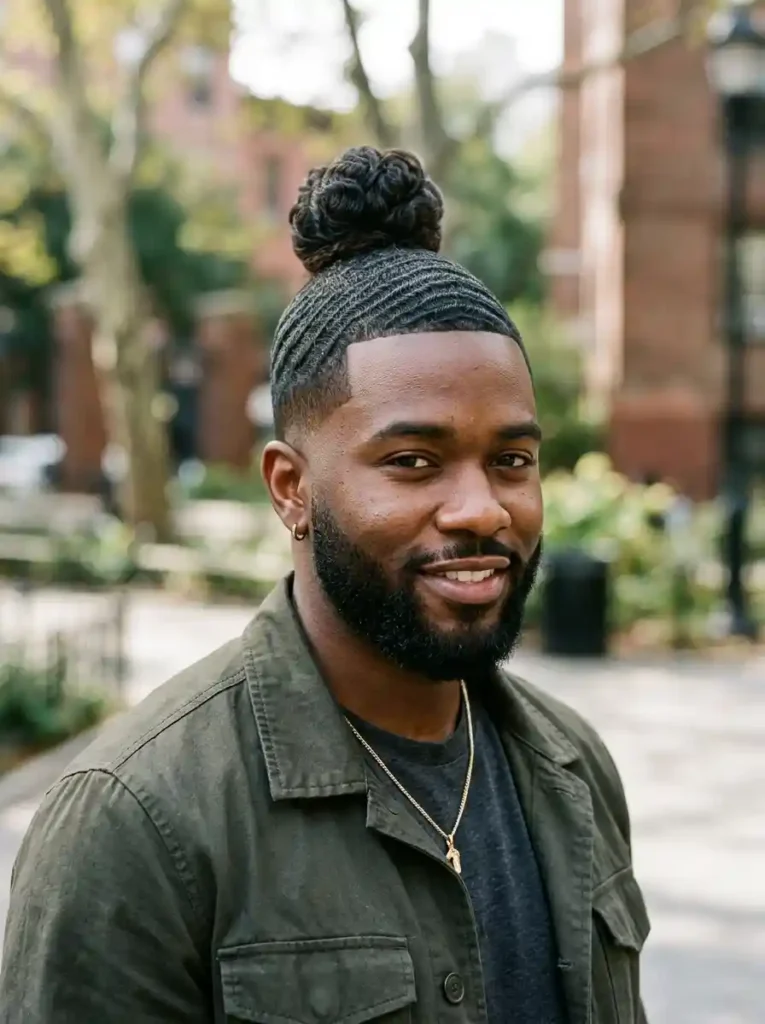
Wearing waves in a top knot is a style that combines two significant commitments: the ongoing discipline of wave training and the patience of growing hair long enough to gather at the crown. The result of maintaining both simultaneously is a top knot that has a textural quality unlike any other, with the wave compression visible in the hair near the roots and at the point of gathering, creating a dimensional pattern that adds depth and visual interest to what would otherwise be a smooth gathered surface. The wave pattern communicates dedication and precision that enhances the overall impression of the style.
Wave training needs to adapt somewhat when the hair is being grown out for a top knot, as longer hair requires more effort to maintain the pattern and the angle of compression changes as the length increases. Men who are committed to both goals find that consistent brushing, especially with a curved wave brush that follows the shape of the head, and regular compression with a durag or wave cap remain the most effective approaches regardless of the length. The skin fade or burst fade at the sides keeps the style sharp and modern while the longer top section continues developing both in length and in wave depth.
13. The Top Knot for Straight Hair
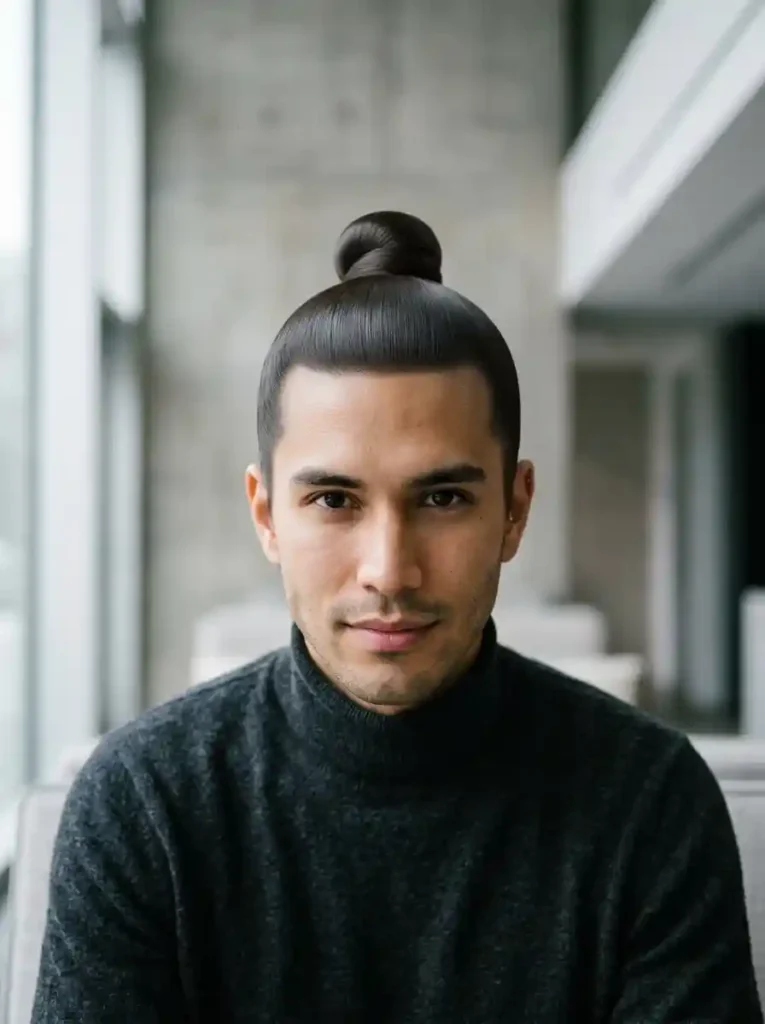
Straight hair produces the cleanest, most geometrically precise version of the top knot, and men with naturally straight hair have a distinct advantage in terms of the smoothness of the gathering and the sleekness of the finished knot. Without the natural texture of waves or curls to create irregularity at the surface, straight hair lies flat from every angle as it is pulled upward toward the crown, creating a style that is almost architectural in its clarity. The gathering point is even, the knot sits symmetrically, and the overall silhouette has a precision that immediately reads as intentional and considered.
The one area where straight hair requires more attention in a top knot is flyaways and fine hairs along the hairline that resist gathering and stand away from the smooth surface. A small amount of a smoothing serum or a light pomade applied to the hairline before gathering brings these hairs into alignment and creates the clean surface from forehead to knot that gives this style its distinctive character. Men with very fine straight hair may find that a volumizing product applied to the roots before gathering helps the knot sit with more presence and substance rather than collapsing flat against the scalp.
14. The Top Knot with Side Part
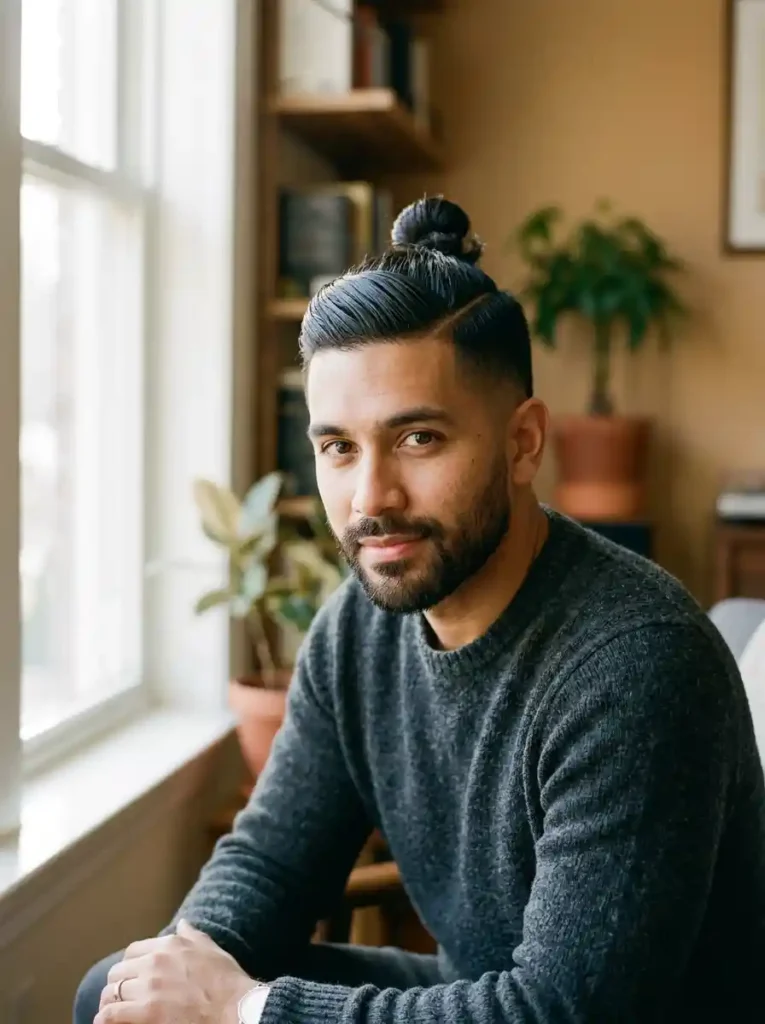
Introducing a clean side part to a top knot creates a style that bridges the gap between casual and formal with considerable elegance. The part is made at a natural or chosen point on one side of the head, the hair on each side of the part is swept in the appropriate direction, and then everything is gathered smoothly into the top knot at the crown. The result is a style that retains the clean, groomed quality of a professional side part while the top knot replaces the typical side-swept finish with something more distinctive and personal.
This interpretation is one of the most appropriate versions of the top knot for formal occasions and professional settings, as the side part signals grooming intention and polish in a way that other top knot variations may not immediately communicate. The sharpness of the part can be enhanced with a fine-toothed comb and a light hold product that keeps the hair lying cleanly in the correct direction from the part to the gathering point. Men who attend formal events with a top knot as their chosen style often find that this variation receives the most positive reception across the broadest range of social and professional contexts.
15. The Top Knot on Locs
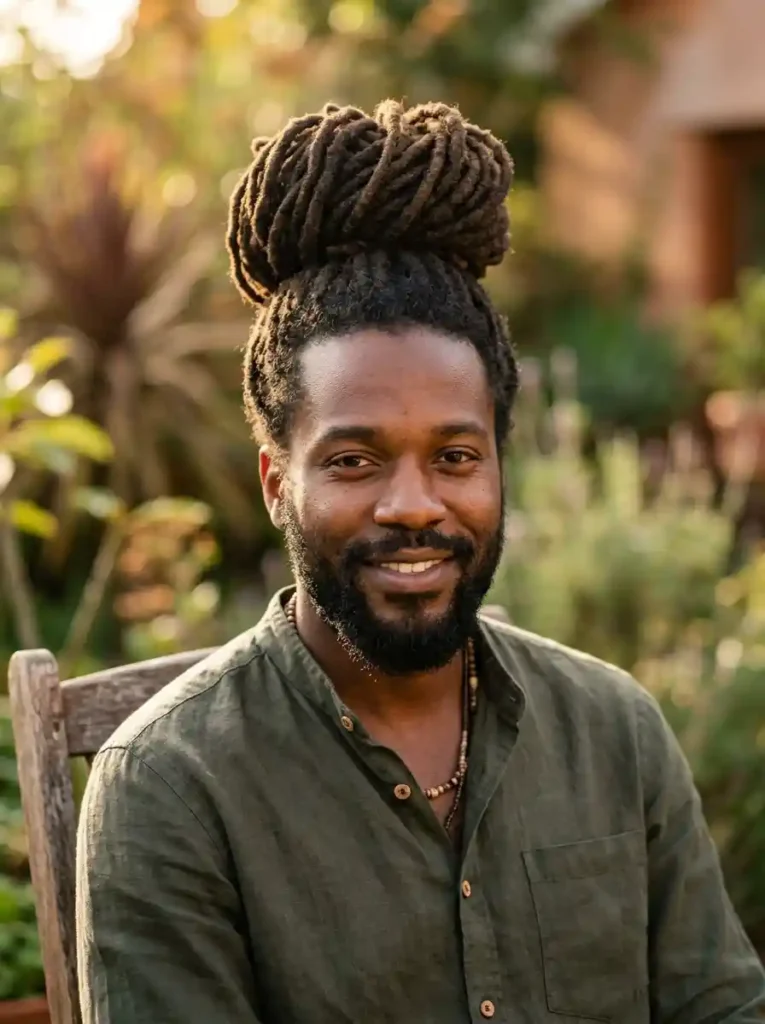
Locs gathered into a top knot create a style that draws from two deeply expressive traditions simultaneously, the protective and cultural significance of locs and the practical elegance of the upward gathered knot. As locs grow to a medium or longer length, they develop enough weight and flexibility to be gathered at the crown, where they form a top knot with a distinctive organic character that is entirely unlike the gathered shape of loose natural or straight hair. The individual loc texture is visible at the surface of the knot and adds a dimensional, sculptural quality to the gathered shape.
The weight of locs makes the top knot a genuinely practical choice for men whose locs have reached a length where they become heavy or warm at the nape and shoulders. Gathering them upward distributes the weight across the crown and provides relief during warmer seasons or active periods. The loc top knot requires a hair tie that can accommodate the thickness and weight of the gathered locs without putting undue tension on any individual loc or on the scalp. A wide fabric elastic or a specialized loc tie works significantly better than a standard hair elastic and prevents the breakage or thinning that can occur at the gathering point with less appropriate hardware.
16. The Top Knot with Tapered Sides
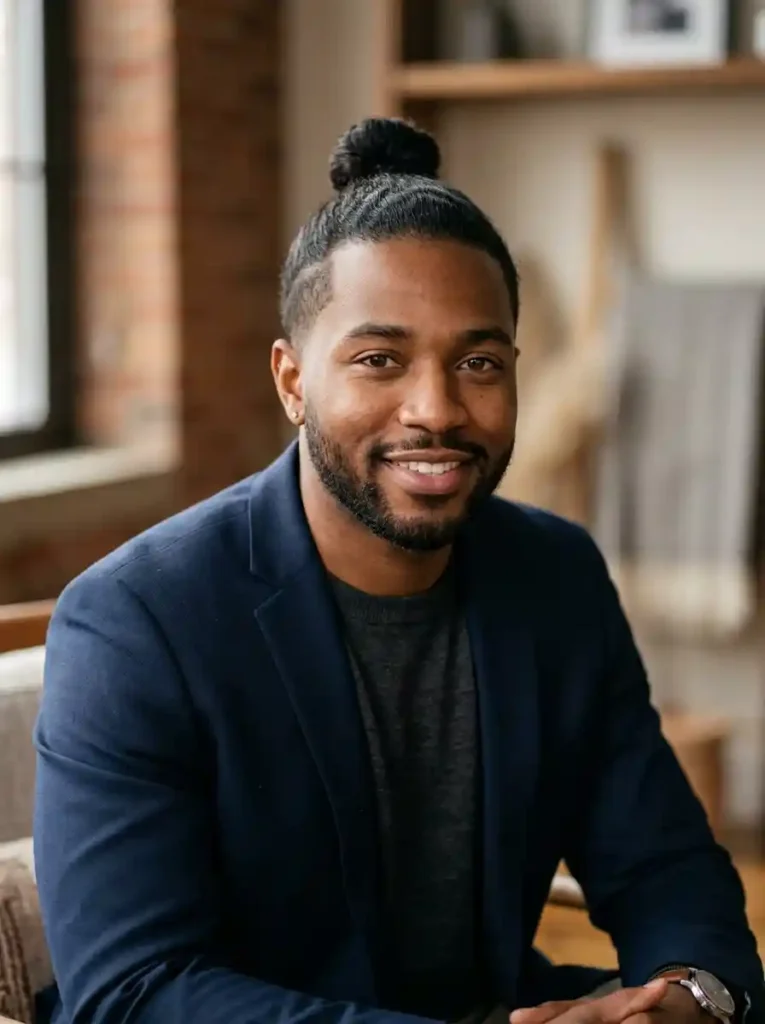
A tapered side rather than a full skin fade gives the top knot a more refined, traditional framing that suits men who want the practical and aesthetic benefits of gathered long hair without the aggressive contrast of a modern barbershop fade. The taper brings the sides and back to a clean, shorter length that blends gradually into the longer top section, creating a smooth transition that looks professional and considered. When the top hair is gathered into the knot, the tapered sides frame it with an understated elegance that suits formal and professional environments particularly well.
This is one of the most broadly versatile combinations in men’s long hair styling because the modesty of the taper makes the overall style appropriate in a wide range of contexts. It does not read as fashion-forward or trend-dependent in the way that a skin fade top knot might, giving it a more enduring, classic quality that ages well across different seasons and style cycles. Men in more traditional professional environments who want to wear their long hair gathered rather than loose often find that the tapered side top knot is the version that receives the best reception from colleagues and clients, communicating grooming consciousness without the deliberate stylistic statement of a high contrast fade.
17. The Top Knot with Hair Accessory
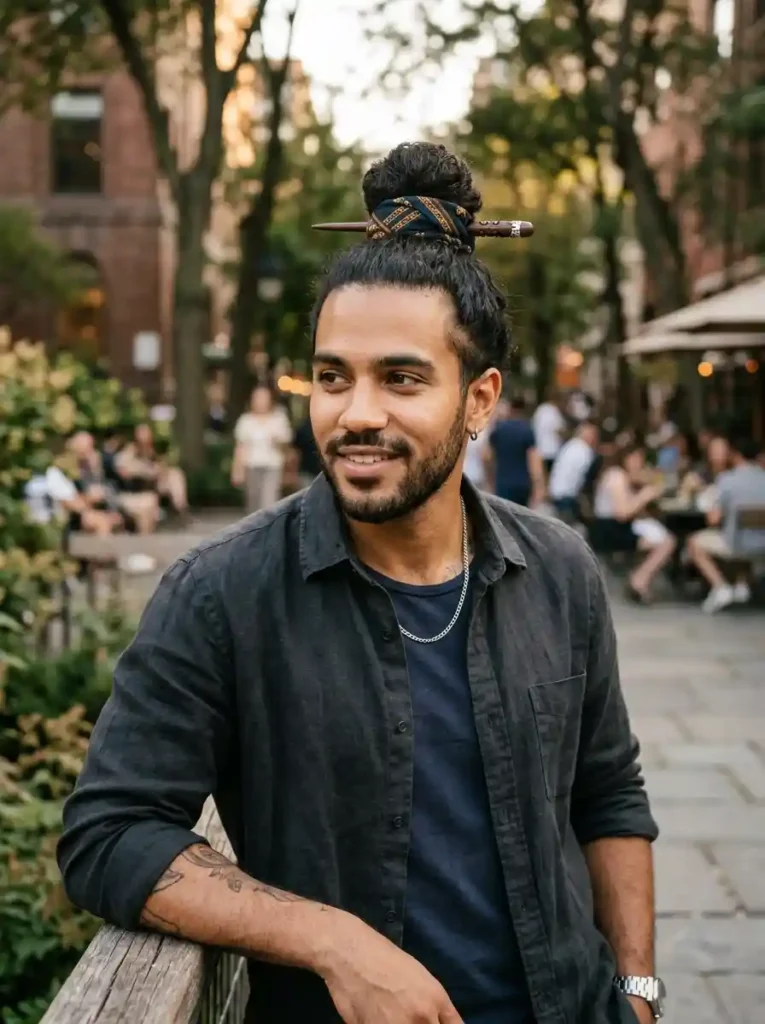
The hardware used to secure a top knot is one of the simplest ways to add a layer of intentionality and personal style to what might otherwise read as a purely practical decision. A wooden hair pin or stick threaded through the knot adds a natural, craft-inspired element. A polished metal ring that wraps around the base of the knot communicates clean minimalism and design awareness. A patterned fabric band or a grosgrain ribbon adds color or texture that can be matched to or intentionally contrasted against the overall outfit. Each accessory choice changes the character of the style significantly.
Men who incorporate hair accessories into their top knot styling are making an active choice to engage with the full range of tools available for self-expression, and this engagement tends to be noticed and appreciated. The key to making a hair accessory work well is proportionality. The accessory should be appropriately scaled to the size of the knot and the thickness of the hair, and it should feel like a considered choice rather than a functional substitute for a missing hair tie. High-quality accessories made from natural materials or refined metals will outlast and outperform cheap alternatives and will remain a positive element of the style across many years of wear.
18. The Top Knot for Thick Hair
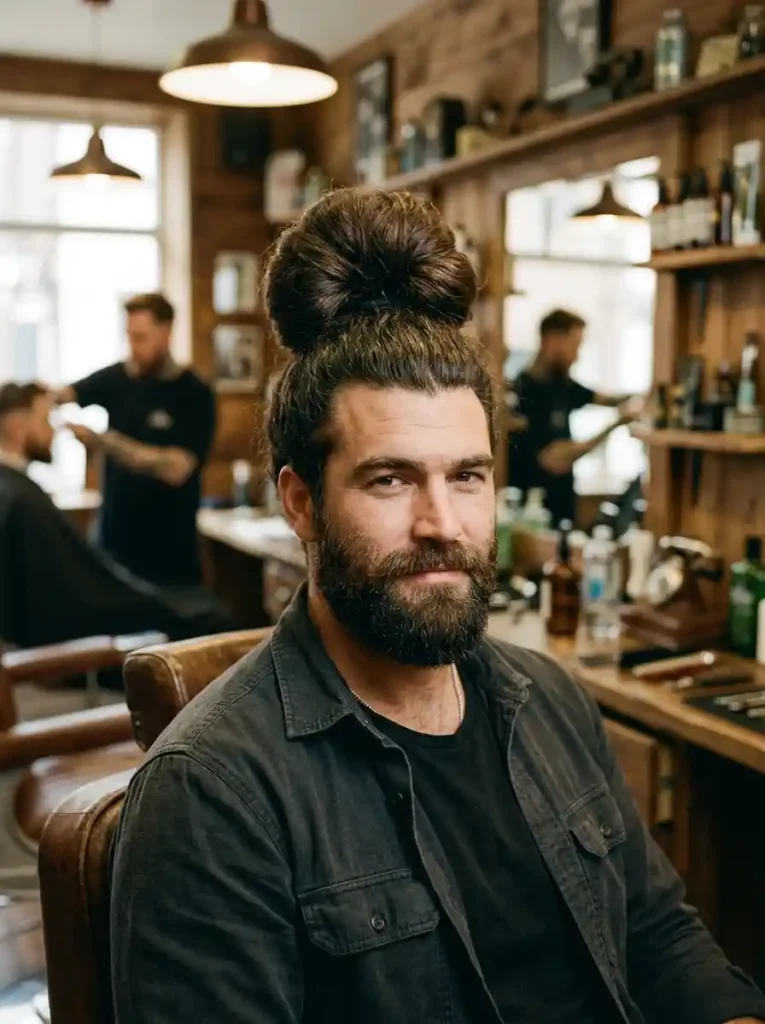
Men with thick hair bring a natural advantage to the top knot in terms of the visual presence and substance of the gathered knot, but thick hair also introduces challenges in the gathering process that require specific attention. The weight and volume of thick hair can make the knot heavy enough to slip or loosen throughout the day unless it is secured with sufficient hardware and the right gathering technique. Using two hair ties layered over each other or a thick, strong fabric elastic provides the holding power that thick hair requires without creating the breakage that pulling against a single standard tie can cause.
The visual payoff of a well-secured thick hair top knot is considerable. The knot itself has genuine presence and roundness that fine or medium hair cannot achieve at the same length, and the weight of the gathered hair creates a knot that holds its shape through the day without collapsing or requiring adjustment. Men with very thick hair may benefit from having the top section thinned slightly by their barber during a trim, as this removes interior bulk without changing the outer volume of the knot and makes the gathering process easier and lighter. This interior thinning is virtually invisible from the outside but significantly improves the daily management of the style.
19. The Top Knot with Middle Part
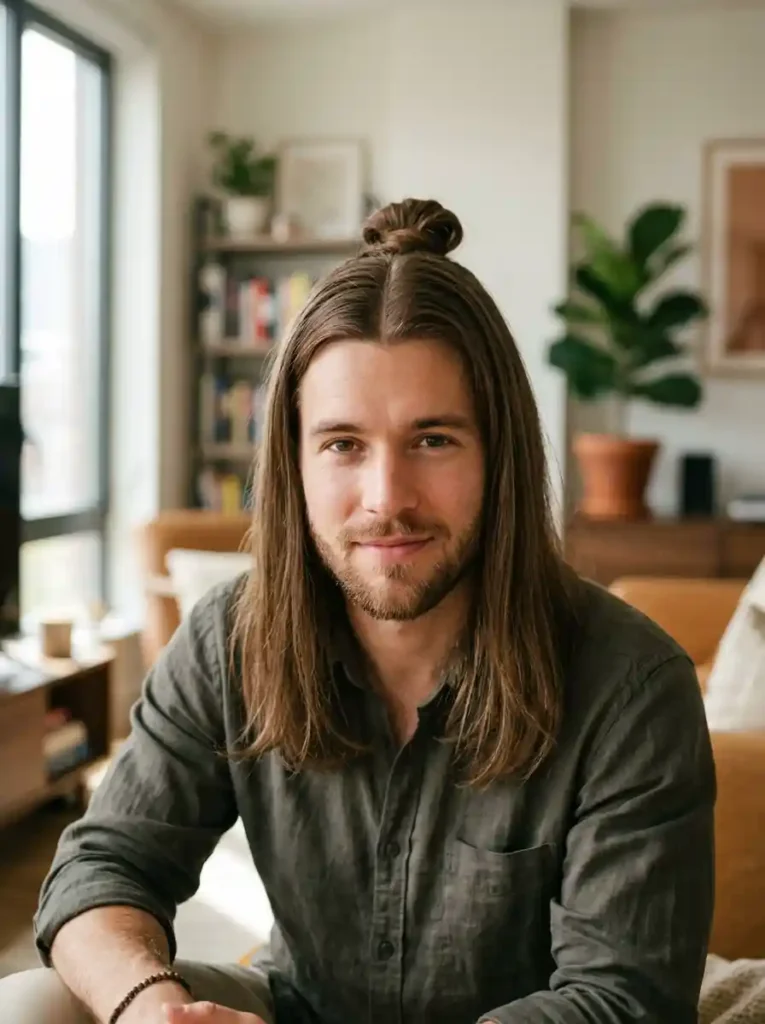
A center part before the top knot gathering creates a style with a distinctly different front-facing silhouette than either a side part or no part at all. The even distribution of hair on both sides of the forehead from the center part creates a symmetrical, balanced framing for the face that has a clean, modern quality popular in contemporary men’s styling. As the hair travels backward and upward from the center part toward the gathering point at the crown, it creates a smooth, continuous surface on both sides that reflects light evenly and emphasizes the symmetry of the overall style.
The center part works best with hair that is long enough to travel cleanly from the forehead all the way back to the crown gathering point without buckling or standing up along the way. Hair at least five to seven inches in length at the front is generally needed for the part and the subsequent backward sweep to function smoothly. A small amount of a light hold product combed through the hair from the center part backward helps maintain the direction of the hair before gathering. Men with slightly wavy hair may find that the center part introduces a natural wave direction that adds movement and character to the surface of the gathered sides.
20. The Top Knot for Fine Hair
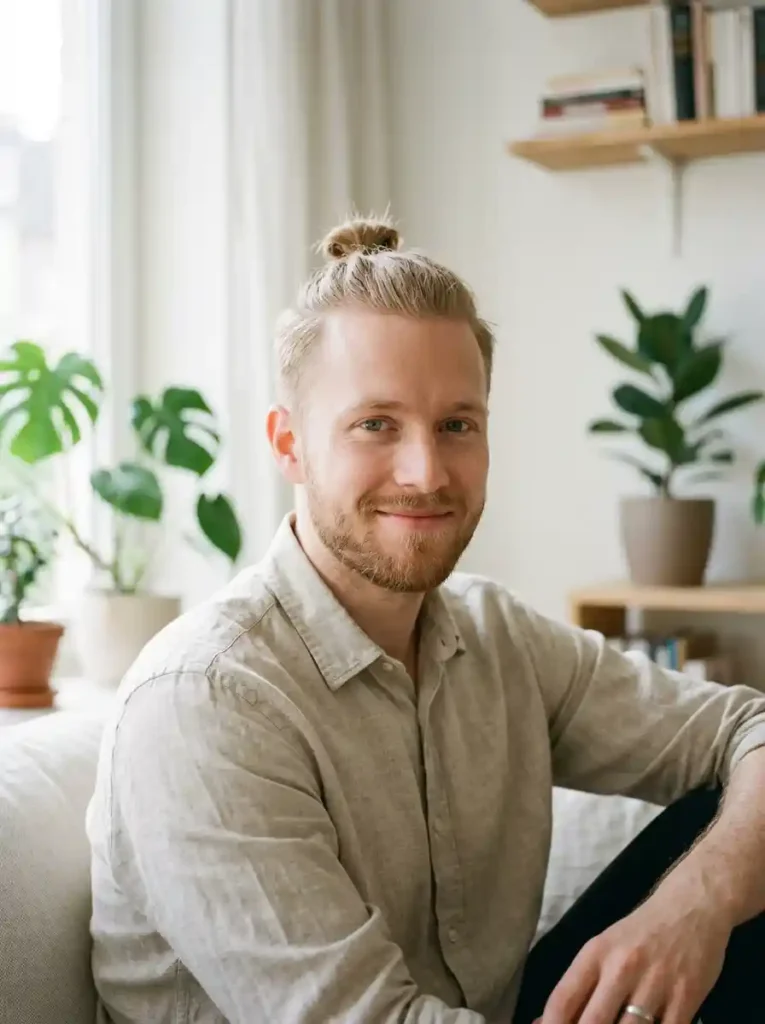
Fine hair presents different challenges for the top knot than thick hair, primarily because the gathered knot tends to sit smaller and flatter than versions with more hair density. Rather than fighting this characteristic, the most successful approach for fine hair is to embrace the delicacy of the style and work with volumizing products that give the hair as much body and lift as possible at the root before gathering. A volumizing mousse applied to damp hair and blow-dried upward before assembly adds significant lift that persists through the gathering process and gives the knot more presence than the same fine hair would have if gathered while flat and air-dried.
Men with fine hair who wear top knots also benefit from being more intentional about the placement of the gathering point. Positioning the knot at the very top of the crown rather than lower at the back of the head gives it the maximum possible visual height, which compensates for the reduced circumference of the knot itself. The style also benefits from the absence of heavy products in the gathering phase, as anything with weight can flatten fine hair further rather than supporting it. Lightweight, flexible-hold finishing products preserve the volume achieved in the blow-drying phase while keeping the gathered hair in place throughout the day.
21. The Top Knot with Natural Gray
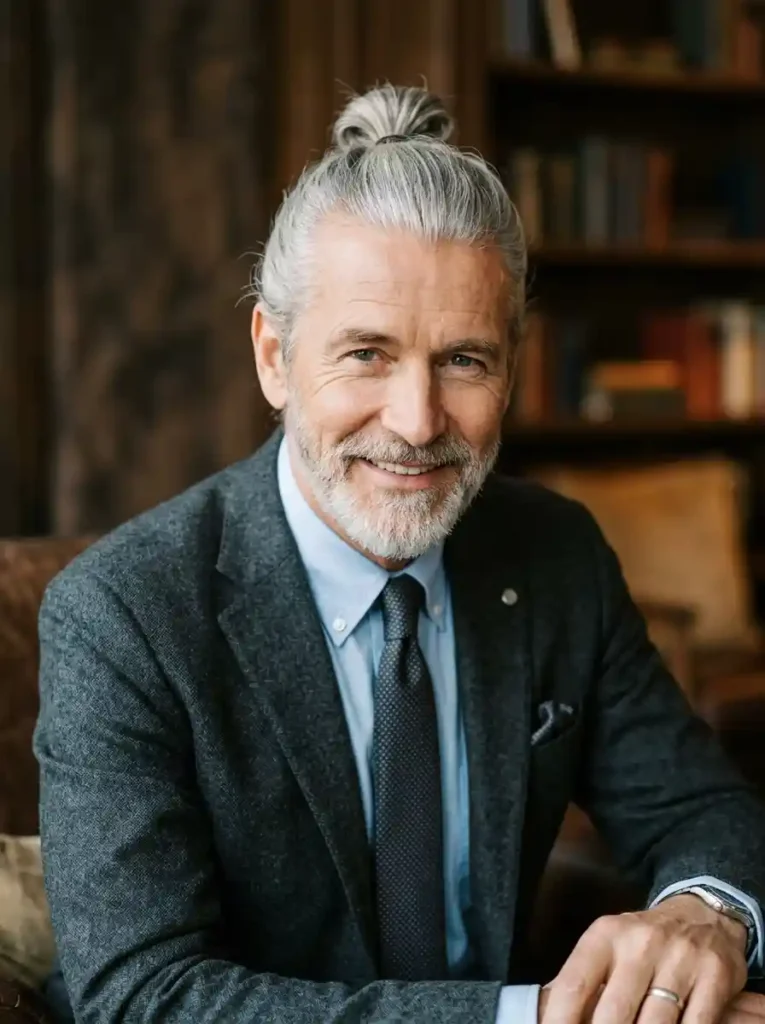
Natural gray or silver hair worn in a top knot creates one of the most quietly powerful style statements available to men who have chosen to embrace the natural progression of their hair color. The silver and gray tones have a luminosity and visual presence that dark hair does not carry in the same way, and when gathered into a top knot, the silver catches the light with a quality that makes the style appear almost deliberately chosen for its aesthetic impact rather than simply allowed to happen. The top knot in gray reads as confident and distinguished rather than as a young person’s style being worn past its natural context.
Maintaining silver and gray hair for a top knot requires particular attention to hydration and shine, as gray hair tends toward dryness and can appear dull or wiry without consistent conditioning. A weekly deep conditioning treatment and a daily leave-in conditioner or a light hair oil keep the silver looking luminous and the hair flexible enough to gather comfortably. Occasional use of a purple or blue toning treatment prevents the warm yellow cast that gray and silver hair can develop over time, keeping the silver tones bright and cool. Men who wear this combination project a sense of comfort in their own evolution that is genuinely attractive and deeply confident.
Conclusion
The top knot is one of those rare hairstyles that grows with the man wearing it, quite literally in the case of the hair itself and figuratively in the way the style deepens in character and confidence with time. What begins as a practical solution for long hair quickly becomes a defining aesthetic choice, one that signals self-assurance, an appreciation for personal expression, and the patience to grow something worth wearing. The twenty-one versions in this collection demonstrate that the top knot is not limited by hair type, age, cultural background, or personal style direction. There is a version that belongs to you specifically, whether that is the clean geometric formality of a skin fade top knot, the organic abundance of a curly or loc-based version, the relaxed wisdom of a natural silver knot, or the deliberate artistry of a style built around braids and design elements. Grow your hair, find your version, and wear it exactly as it was meant to be worn, with absolute confidence.
Which top knot style would you try first? Tell us in the comments below and share this with a friend who is growing out his hair right now.